mean value property:u(x0,y0)=2π1∫02πu(z0+reiθ)dθ where z0=x0+iy0
maximum principle:有极大值或极小值则为常值函数,最大最小值只能在边界取到
harmonic conjugates’ level curve(等值线) are orthogonal(梯度不为零的时候谈论才有意义)
exam1
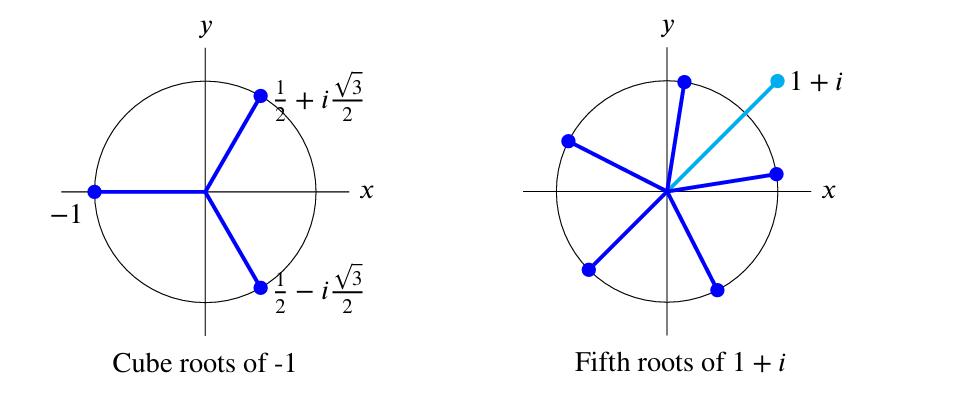
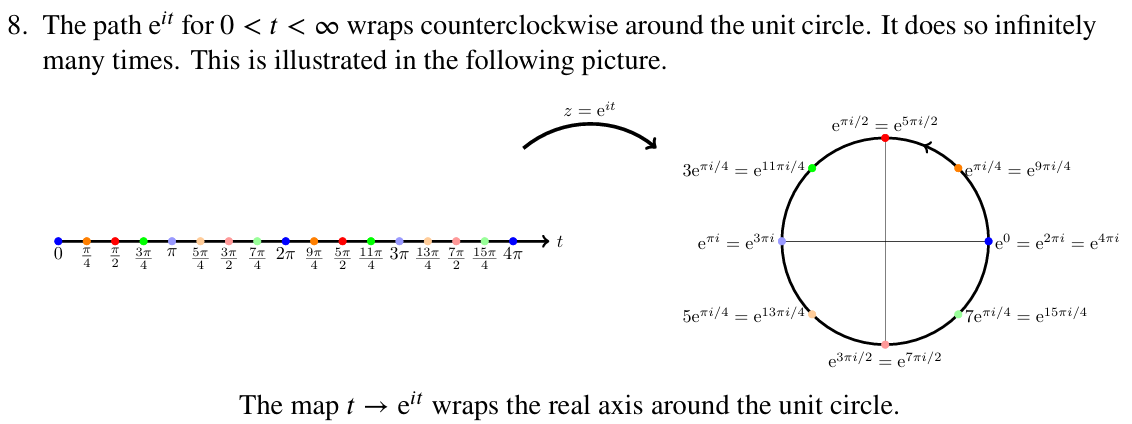
欧拉公式在x为复数的情况下依然成立
show that the following function maps the upper plane to the unit circlef(z)=z+iz−i
solution:
first show that the function maps real axis to the circle
then show maps origin to the zero,it’s enough to say the conclusion
Cauchy–Riemann中的x,y是针对的直角坐标,不能把极坐标直接拿来算
极坐标下的关系式:ur=r1vθvr=−r1uθ
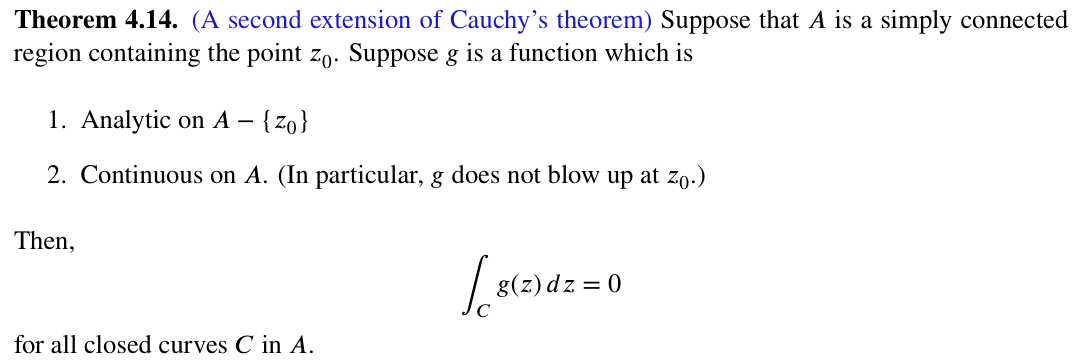
cauchy’s integral formula理解:仅要求分子的g(z)在区域内解析,整个式子是允许z−a1在a处有奇点的
本身刻画的就是围绕一阶奇点的积分的关系
Two dimensional hydrodynamics and complex potentials
hydrodynamics:流体动力学 potentials:势
velocity field(速度场),如果和时间无关即可称为stationary flow incompressibility:div equals to zero irrotational flow:curl zero
e.g:F=ay(shearing flow is rotational),the above flows faster ,negative sign indicates that the curl is clock-wise
potentials and streams
Φ=ϕ+iψ:the complex potential function,real part the potential function,imag stream function
the derivative be complex velocity F=∇ϕ=(ϕx,ϕy):=(u,v):must be divergence and rotation free
incompress and irrotation always has the complex potential function
e.g:
F=a(r2x,r2y)Φ′=u−iv=zzˉazˉ=zaso we haveΦ=alogz
stream function:velocity field F is tangent to(与其相切) the level curve of ψ every where
stagnation points:where velocity field equals to zero
Taylor and Laurent series
geometric series:f(x)=a∑i=0∞xi
convergence of power series
f(z)=n=0∑∞an(z−z0)nthere exist a number R such thatif the R>0,then the series converge to an analytic function on region∣z−z0∣<Rthe series diverge in∣z−z0∣>R,R and the region:divergence radius diskthe derivative is given by term by term differentiationthe line integral along the divergence disk is given by term by term integration
test:
radio test:就是比值绝对值判别收不收敛
root test:开n分之一次方的根
Taylor
singularity
zero are isolated:if f is analytic and not identical to zero in region A,if f(z)=0,then we can draw small disk around z contains no zero
the first non-zero Taylor coefficient ak ,then k is the order of zero of f at that point
1+z21加变减直接几何级数即可,negative power of z is called singular part,summation called regular\analytic part
a function is singular at point if it’s not analytic
isolated singularity:the deleted disk around point where analytic
laurent
series
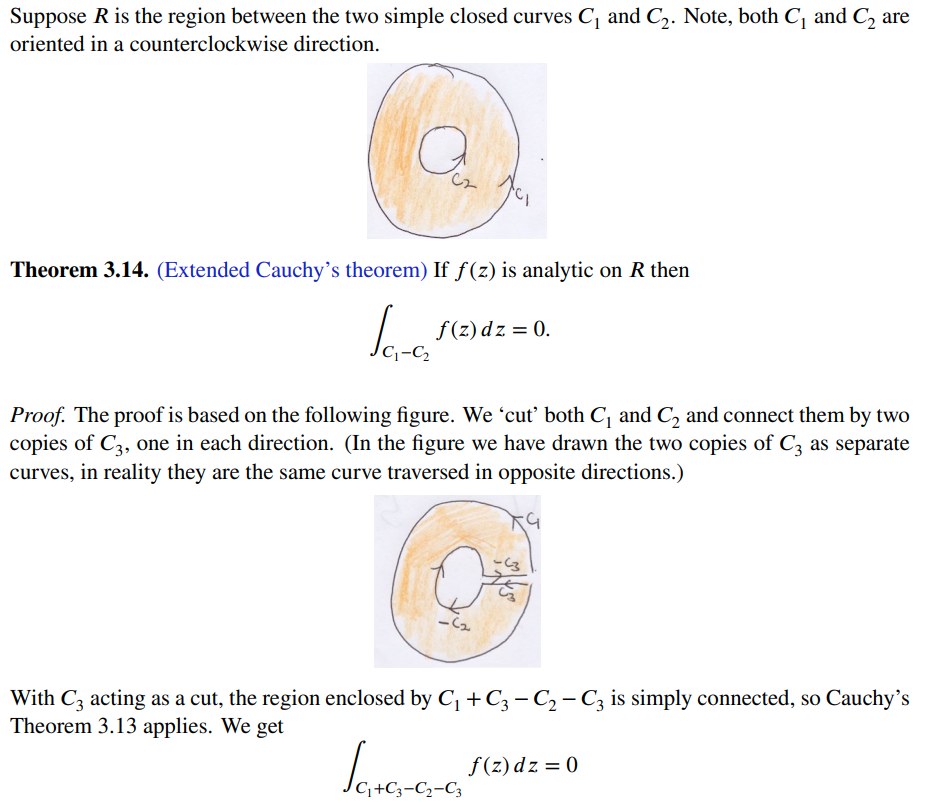
suppose that f(z) is analytic on annulus r1<∣z−z0∣<r2
then f(z)=n=1∑∞(z−z0)nbn+n=0∑∞an(z−z0)n
where an=2πi1∫γ(w−z0)n+1f(w)bn=2πi1∫γf(w)(w−z0)n−1
前一项(analytic or regular part)在大于r1的地方是收敛的,后一项(singular or principal part)在小于r2的地方是收敛的
级数的实际表达式取决于region
sometimes we can use series to solve differential equation,just set the series and compare the coefficient
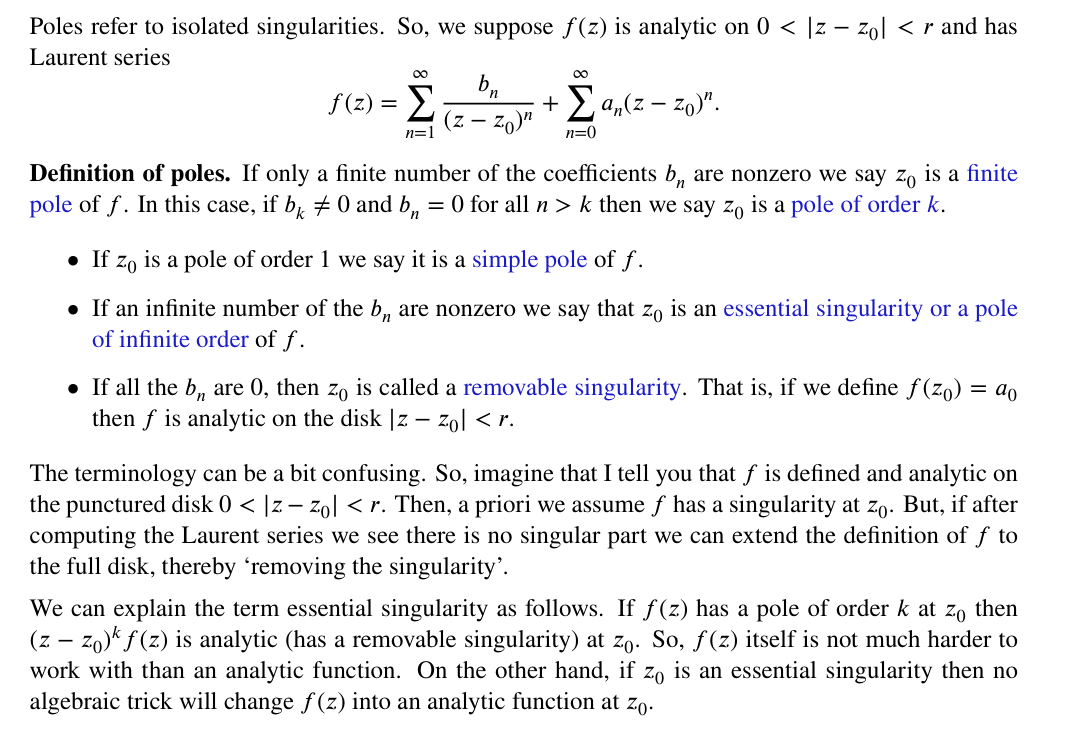
poles
residue
consider the function f with isolated singularity at z0,i.e at 0<∣z−z0∣<r,the residue at z0 is b1
denoted by Res(f,z0) or z=z0Resf=b1
if γ is small,simple closed curve ∫γf(z)=2πib1
problemset4&5
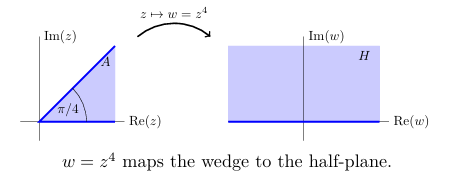
找函数满足边界都是0,axis of x,04π四次方就能映射到整个上半平面(指数表达方法)
Residual theorem
pole(zero):分式(整式)的次数
holomorphic:equal to analytic
meromorphic:a function analytic except a set of poles of finite orders
behavior near zero and pole f(z)≈an(z−z0)n (zero) (z−z0)nbn (pole)
Picards theorem
if a function has essential singularity(不是可去奇点也不是极点的奇点) at z0,then in the neighbor of it,the function take on all values infinite times possibly except one value
quotient of function(函数的商) h(z)=g(z)f(z)
let f has zero of order m,g has zero of order n,then h(z) has zero of order m-n(negative means n-m pole),m=n mean analytic
residue at simple pole
suppose f has isolated singularity at z0
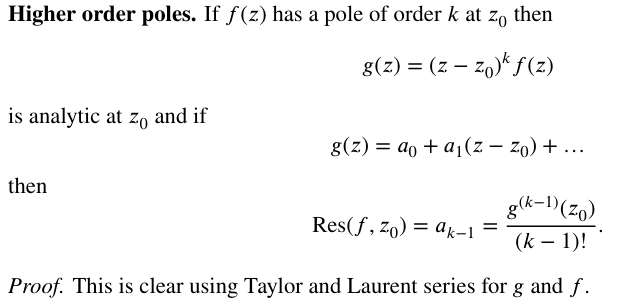
if g(z)=(z−z0)f(z) is analytic around point,then this point is either simple pole or removable singularity,Res(f,z0)=g(z0)
if f(z) has simple pole,then z→z0lim(z−z0)f(z)=Res(f,z0),limit exist also means simple pole or analytic
f has simple pole and g analytic,then Res(fg,z0)=g(z0)Res(f,z0) and if g not zero Res(f/g,z0)=g(z0)1Res(g,z0)
if g has simple zero,then 1/g has a simple pole and Res(1/g,z0)=g′(z0)1
residue at finite pole
cot(z)
it’s fact that this function has simple pole at nπ and residue of 1 at these point
cauchy residue theorem
f在A上解析,有若干isolated singularities,C为不经过奇点的单连通区域边界,C上的线积分 ∫Cf(z)dz=2πi∑ residues of f inside C
residue at ∞
definition:
when the curve is counter-clockwised,the interior is inside,when clockwised,the interior is outside
the value of integral is defined as Res(f,∞)=−2πi1∫Cf(z)dz
where C is big enough to contain all singularities Res(f,∞)=−Res(ω21f(ω1),0)