complex algebra and plane

复数的模:magnitude,absolute value,norm,modulus
z=x+yi=reiθ where r is the magnitude,theta is the argsz=x+yi=re^{i\theta}\text{ where r is the magnitude,theta is the args}

  • complexification(complex replacement)
    对于

I=excos2xdxIc=(excos2x+iexsin2x)dxI=Re(Ic)\begin{aligned} I=\int e^xcos2xdx\\\\ I_c=\int (e^xcos2x+ie^xsin2x )dx\\\\ I=Re(I_c) \end{aligned}

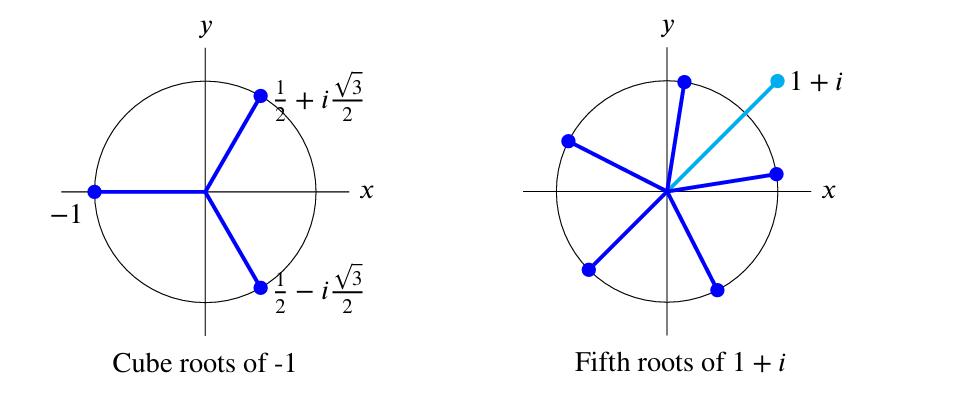
  • find nth root
    • 一个很方便的方法就是变成指数形式
    • geometry:
      0c1d9c82361467abdd26984bbf893fe8.png
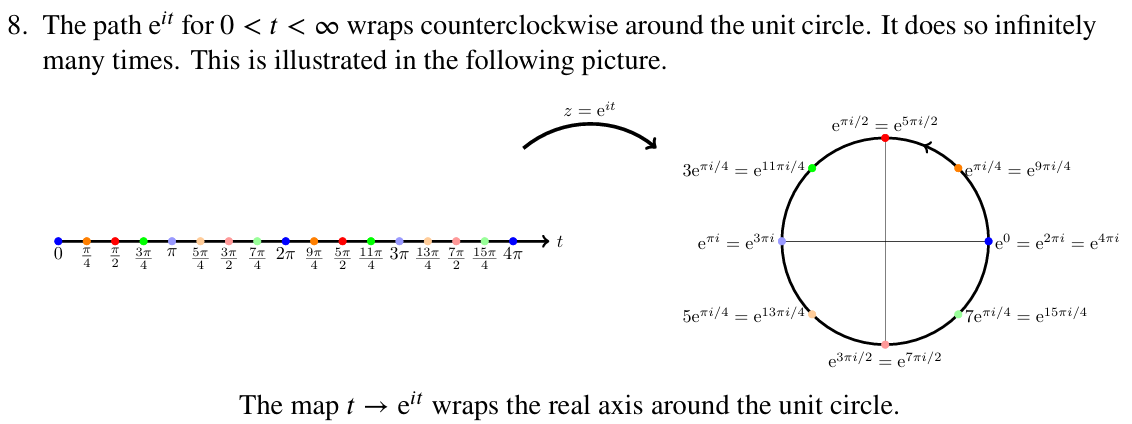
  • inverse eular formulars

cost=eit+eit2sint=eiteit2i\begin{aligned} cost=\frac{e^{it}+e^{-it}}{2}\\\\ sint=\frac{e^{it}-e^{-it}}{2i} \end{aligned}

  • de Moivre’s formula
    (cosθ+isinθ)n=cos(nθ)+isin(nθ)(cos\theta +isin\theta)^n=cos(n\theta)+isin(n\theta)
  • 矩阵形式

z=Re(z)×[1001]+Im(z)×[0110]\begin{aligned} z=Re(z)\times \begin{bmatrix} 1&0\\\\0&1 \end{bmatrix}+Im(z)\times \begin{bmatrix} 0&-1\\\\1&0 \end{bmatrix} \end{aligned}

这样复数乘法即可变为矩阵乘法

  • polar form(stretch and rotation)

Z=[r00r][cosθsinθsinθcosθ]\begin{aligned} Z=\begin{bmatrix} r&0\\\\0&r \end{bmatrix} \begin{bmatrix} cos\theta&-sin\theta\\\\sin\theta&cos\theta \end{bmatrix} \end{aligned}

ba1e49dd4d70f8f96e7e7f8321064d55.png

  • complex functions as map
    • 不好可视化,这里视作映射
    • w=f(z)equal to zww=f(z)\text{equal to }z\mapsto w
  • punctured plane:去除原点的复平面
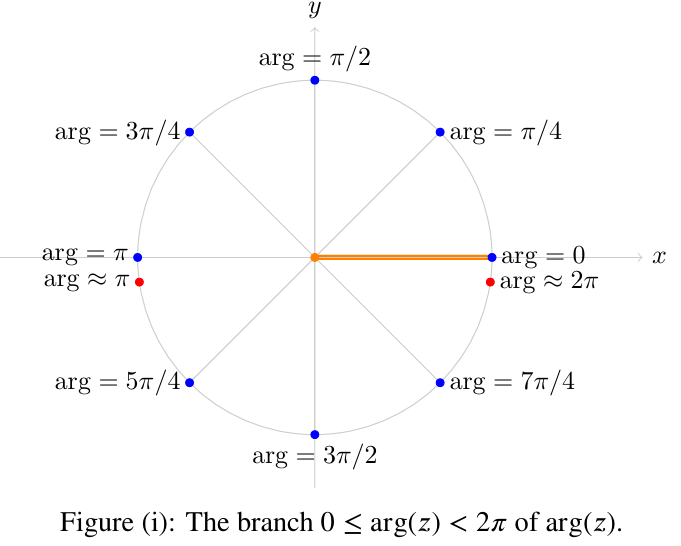
  • the function of arg(z)
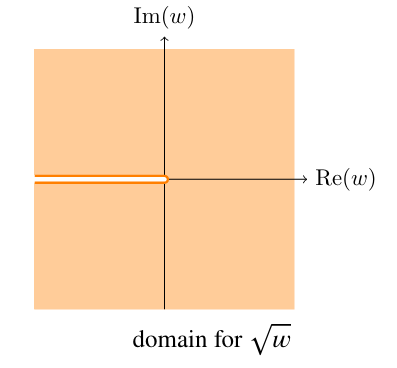
    • the branch:我们选择了一个区间使得该函数变成单值的(指定函数取我们列出的值中)
      b433fc9233b2cb1b913d7fbeb53bff17.png
      • 2pi处的不连续是无法避免的(橙线称为branch cut想连续就得除开该cut)
    • the principle branch of arg:-pi~pi,denoted by Arg(z)
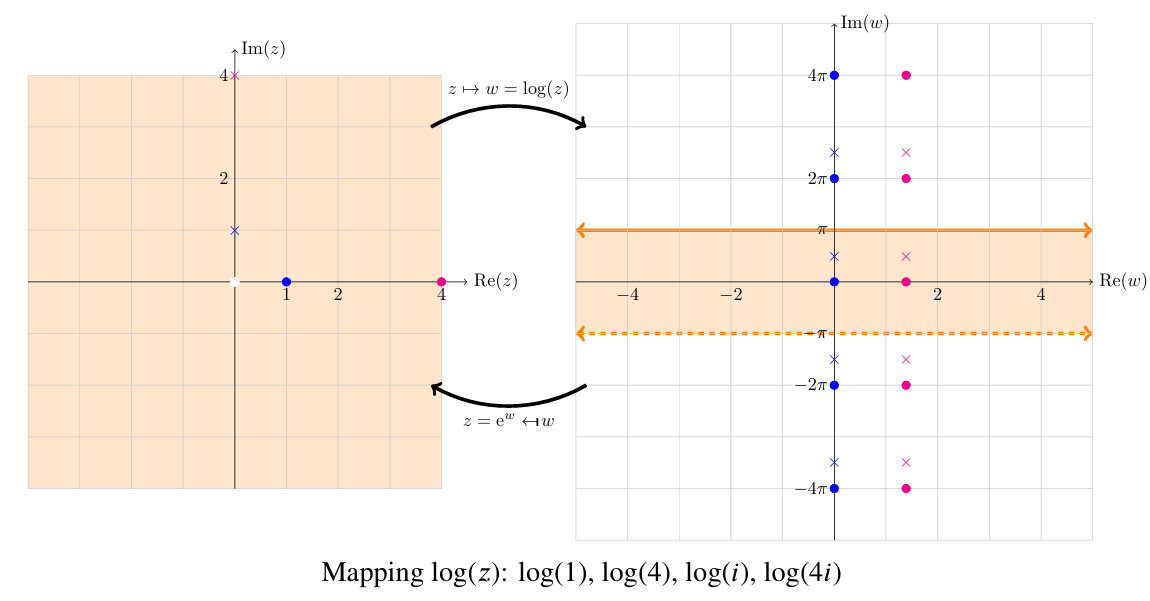
  • the function log
  • we want to define it as the inverse of exponential
    log(z)=log(z)+iarg(z)log(z)=log(|z|)+iarg(z)
    • log 0 未定义,principle branch 仍然是-pi~pi
      11d2ac7c79fe91ddff011474033de2de.png
      • map circle to verticle line segment,ray to horizontal line
  • power:za=ealog(z)z^a=e^{alog(z)}

analytic function

  • a function is analytic if it has complex derivative
  • open disk of r around z:all the points within the radius r of z
  • open deleted disk=punctured disk(扣掉原点)
  • 极限趋于某复数<=>实部和虚部分别趋近某值
  • 只要它实部和虚部都连续它本身就连续
  • the point at infinity:
    • extended complex plane=C{}\mathbb{C}\cup\{\infty\}
    • one point at infinity:任何模趋近于无穷的序列都趋近于该无穷
    • 1=0\frac{1}{\infty}=0
    • the neighborhood of infinity:除开原点为圆心的圆

Stereographic projection from the Riemann sphere

(黎曼球面的立体投影)

  • 复平面上放个球,从北极点(0,0,1)进行投影,球上的点与平面的点一一对应
    P(a,b,c)z=a+bi1cP(a,b,c)\mapsto z=\frac{a+bi}{1-c}

df1(z)dz=1f(f1(z))\frac{df^{-1}(z)}{dz}=\frac{1}{f^{\prime}(f^{-1}(z))}

  • cauchy-Riemann equation

for analytic function f(z)=u(x,y)+iv(x,y)f(z)=ux+ivx=vyiuy\begin{aligned} \text{for analytic function } f(z)=u(x,y)+iv(x,y) \\\\f^{\prime}(z)=\frac{\partial u}{\partial x}+i\frac{\partial v}{\partial x}=\frac{\partial v}{\partial y}-i\frac{\partial u}{\partial y} \end{aligned}

逆定理也成立

矩阵视角的复数求导(就是雅可比矩阵)

f(x)=[uxuyvxvy] where f(x)=u(x,y)+iv(x,y)\begin{aligned} f^{\prime}(x)= \begin{bmatrix} u_x&u_y\\\\v_x&v_y \end{bmatrix} \text{ where }f(x)=u(x,y)+iv(x,y) \end{aligned}

  • u,v二阶导存在且连续,则若f=u+iv可导,其导数也可导

  • entire function:analytic on the complex plane

bf6d769ed9b2976bd3ed0deefab0583b.png
b05192646e69542c22de0e85c242ef27.png

  • 导数可能比原函数在更大的范围上analytic,但是反过来是不可能的
    c45196bd4d8f049be2b616ada1011268.png

review calculus

  • curl(旋度):F(x,y)=(M(x,y),N(x,y))=>curlF=NxMyF(x,y)=(M(x,y),N(x,y))=>curlF=N_x-M_y
  • divergence(散度)Mx+NyM_x+N_y
  • F为f的梯度,则f为potential funcion(势函数)
  • 路径无关:保守向量场(在联通区域保守场和梯度场等价)
  • 联通区域上保守向量场等价于旋度为0(simply connected:每一条内部曲线的内部都在区域中)
  • 通量(flux)=所围区域内部的散度的积分(CFnds=RdivFdxdy\int_C \mathbb{F}\cdot \mathbb{n}ds=\int\int_R div\mathbb{F}dxdy)

Line integrals and Cauchy’s theorem

  • complex line integral:γf(z)dz=(u+iv)(dx+idy)=f(γ(t)γ(t))dt\int_\gamma f(z)dz=\int (u+iv)(dx+idy)=\int f(\gamma(t)\gamma^{\prime}(t))dt
  • fundamental theorem of complex line integral:

if f(z) is a complex analytic function on an open region,thenγf(z)dz=f(z1)f(z0)\begin{aligned} \text{if f(z) is a complex analytic function on an open region,then}\\\\ \int_{\gamma}f^{\prime}(z)dz=f(z_1)-f(z_0) \end{aligned}

  • path independence:if the function f(z) has antiderivative on region A,then it’s integral is path independent on A
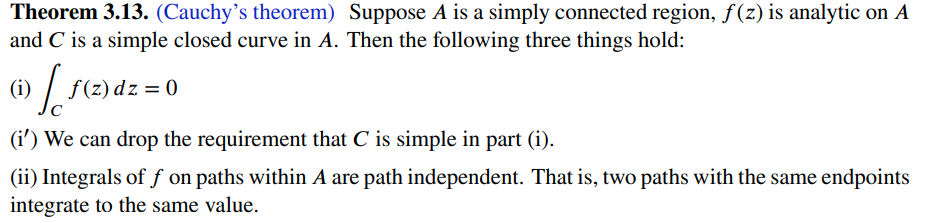
  • cauchy’s theorem
    42ec0efd85f4dac1a7bafaf40cf0d7e3.png
    • the third : f has an antiderivative
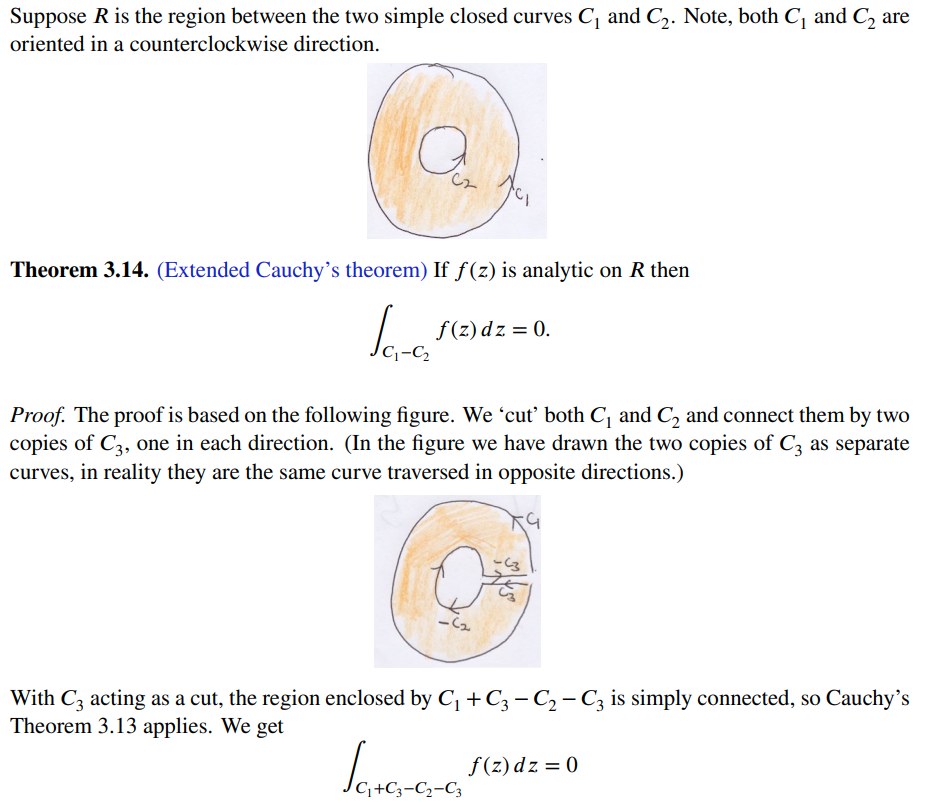
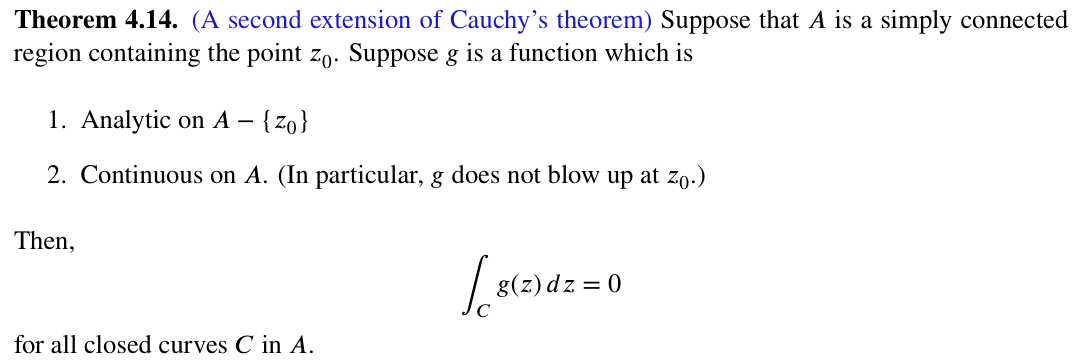
  • extension of cauchy’s:it demand the function to be analytic on the simply connected region
    4dd7bfab9bcc82f72f638bb13dc6f067.png
  • definition:winding number is the number of times the curve goes around the origin zero counterclockwise
    • also equal to the times across the x-axis ,+1 from below
  • 只有当函数在给定区域analytic才有推广到复数的微积分基本定理

cauthy’s integral formula

  • C为简单闭曲线,函数在C及其内部解析,对C内任一点(c是线就不行)

    f(z0)=12πiCf(z)zz0dzf(z_0)=\frac{1}{2\pi i}\int_C\frac{f(z)}{z-z_0}dz

    只要知道边界就能知道区域内的任一点
    导数

    f(n)(z)=n!2πiCf(w)(wz)n+1dwf^{(n)}(z)=\frac{n!}{2\pi i}\int_C\frac{f(w)}{(w-z)^{n+1}}dw

triangle inequality

z0+z1z0+z1z0z1z0z1gf(z)dzgf(z)dzgf(z)dzgf(z)dzwhere the z represent the complex variable\begin{aligned} |z_0+z_1|\le|z_0|+|z_1| \\\\ |z_0-z_1|\ge|z_0|-|z_1|\\\\|\int_g f(z)dz|\le \int_g |f(z)|dz\\\\ |\int_g f(z)dz|\le \int_g |f(z)||dz|\\\\\text{where the z represent the complex variable} \end{aligned}

wonderful ex

+1(x2+1)2dx\int_{-\infty}^{+\infty}\frac{1}{(x^2+1)^2}dx

  • 思路:实数上的积分视作复平面上的实数轴的积分,先给出一个以R为半径的半圆计算积分然后令R趋近于无穷,这里注意计算曲线积分使用夹逼定理

proof

c7e28595bf02ff58ac33b27f24938a29.png

consequence

  • analytic implies existence of all order derivatives
  • inequality:7032a354560fae3cd84c1a70c92d0718.png
  • entire+bounded implies the function is just a constant
  • maximum modulus principle:非常数的解析函数模长在区域内不可能取极大值,最大值只能在边界取到
  • mean value property:在A上解析:f(z0)=12π02πf(z0+reiθ)dθf(z_0)=\frac{1}{2\pi}\int_0^{2\pi}f(z_0+re^{i\theta})d\theta

problemset3

f(z)=zˉf(z)=\bar{z}这个函数不analytic,实际上在任意点处都不可微
the plane except the non-negative real axises can be simply connected(no whole)

harmonic functions

(调和函数)
definition:a function is harmonic if it’s twice differentiable and satisfy the Laplace’s Equation

2u=uxx+uyy=0\nabla^2u=u_{xx}+u_{yy}=0

the operator 2\nabla^2 is called Laplacian

  • theorem:If a function of z=x+iy f(z)=u(x,y)+iv(x,y) is analytic on region A,then both u and v are harmonic on region A
    • note:analytic->infinite differentiable so twice derivative continuous,mix partial agree
  • theorem:any harmonic function u(x,y) on an simply connected region is the real part of an analytic function

properties

definition:u and v are harmonic conjugates if they are real part and image part of an analytic function

alt text
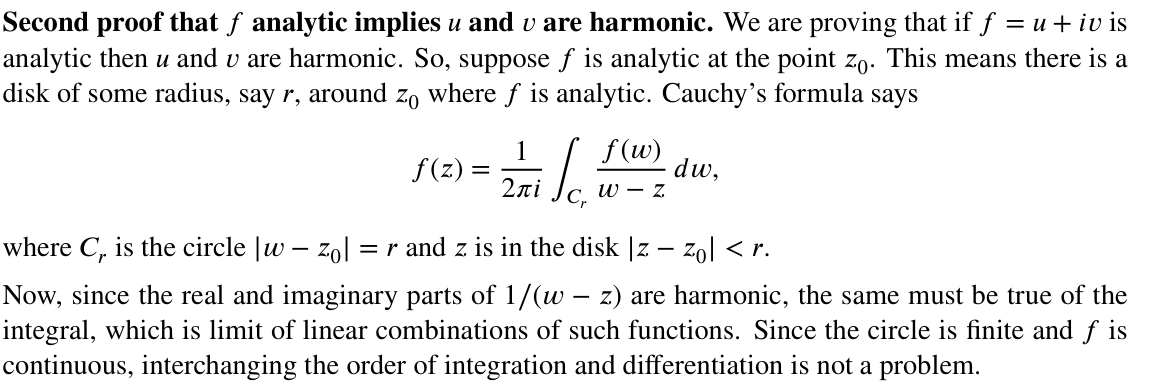
(调和函数具有线性性,积分为连续线性组合的极限)
积分本质上是多个函数值按权重求和取极限
解析函数实际上=调和函数的共轭对=调和核的积分

  • mean value property:u(x0,y0)=12π02πu(z0+reiθ)dθ where z0=x0+iy0u(x_0,y_0)=\frac{1}{2\pi}\int_0^{2\pi}u(z_0+re^{i\theta})d\theta\text{ where }z_0=x_0+iy_0
  • maximum principle:有极大值或极小值则为常值函数,最大最小值只能在边界取到
  • harmonic conjugates’ level curve(等值线) are orthogonal(梯度不为零的时候谈论才有意义)

exam1

  • 欧拉公式在x为复数的情况下依然成立
  • show that the following function maps the upper plane to the unit circlef(z)=ziz+i\text{show that the following function maps the upper plane to the unit circle}f(z)=\frac{z-i}{z+i}

solution:
first show that the function maps real axis to the circle
then show maps origin to the zero,it’s enough to say the conclusion

  • Cauchy–Riemann中的x,y是针对的直角坐标,不能把极坐标直接拿来算
    • 极坐标下的关系式:ur=1rvθu_r=\frac{1}{r}v_{\theta} vr=1ruθv_r=-\frac{1}{r}u_{\theta}
  • cauchy’s integral formula理解:仅要求分子的g(z)在区域内解析,整个式子是允许1za\frac{1}{z-a}在a处有奇点的
    • 本身刻画的就是围绕一阶奇点的积分的关系

Two dimensional hydrodynamics and complex potentials

  • hydrodynamics:流体动力学 potentials:势
  • velocity field(速度场),如果和时间无关即可称为stationary flow incompressibility:div equals to zero irrotational flow:curl zero
  • e.g:F=ay(shearing flow is rotational),the above flows faster ,negative sign indicates that the curl is clock-wise

potentials and streams

Φ=ϕ+iψ\Phi=\phi+i\psi:the complex potential function,real part the potential function,imag stream function
the derivative be complex velocity
F=ϕ=(ϕx,ϕy):=(u,v)\mathbb{F}=\nabla\phi=(\phi_x,\phi_y):=(u,v):must be divergence and rotation free
incompress and irrotation always has the complex potential function

  • e.g:

F=a(xr2,yr2)Φ=uiv=azˉzzˉ=azso we haveΦ=alogz\begin{aligned} F=a(\frac{x}{r^2},\frac{y}{r^2})\\\\\Phi^{\prime}=u-iv=\frac{a\bar{z}}{z\bar{z}}=\frac{a}{z}\\\\\text{so we have}\Phi=alogz \end{aligned}


  • stream function:velocity field F is tangent to(与其相切) the level curve of ψ\psi every where
  • stagnation points:where velocity field equals to zero

Taylor and Laurent series

geometric series:f(x)=ai=0xif(x)=a\sum_{i=0}^\infty x^i

  • convergence of power series

f(z)=n=0an(zz0)nthere exist a number R such thatif the R>0,then the series converge to an analytic function on regionzz0<Rthe series diverge inzz0>R,R and the region:divergence radius diskthe derivative is given by term by term differentiationthe line integral along the divergence disk is given by term by term integration\begin{aligned} f(z)=\sum_{n=0}^{\infty}a_n(z-z_0)^n\\\\ \text{there exist a number R such that}\\\\ \text{if the R>0,then the series converge to an analytic function on region}|z-z_0|<R\\\\ \text{the series diverge in}|z-z_0|>R,\text{R and the region:divergence radius\ disk}\\\\ \text{the derivative is given by term by term differentiation}\\\\ \text{the line integral along the divergence disk is given by term by term integration} \end{aligned}

  • test:
    • radio test:就是比值绝对值判别收不收敛
    • root test:开n分之一次方的根

Taylor

  • singularity
    • zero are isolated:if f is analytic and not identical to zero in region A,if f(z)=0,then we can draw small disk around z contains no zero
    • the first non-zero Taylor coefficient aka_k ,then k is the order of zero of f at that point
    • 11+z2\frac{1}{1+z^2}加变减直接几何级数即可,negative power of z is called singular part,summation called regular\analytic part
    • a function is singular at point if it’s not analytic
    • isolated singularity:the deleted disk around point where analytic

laurent

  • series
    suppose that f(z) is analytic on annulus r1<zz0<r2r_1<|z-z_0|<r_2
    then f(z)=n=1bn(zz0)n+n=0an(zz0)nf(z)=\mathop{\sum}\limits_{n=1}\limits^{\infty}\frac{b_n}{(z-z_0)^n}+\mathop{\sum}\limits_{n=0}\limits^{\infty}a_n(z-z_0)^n
    where an=12πiγf(w)(wz0)n+1a_n=\frac{1}{2\pi i}\int_{\gamma} \frac{f(w)}{(w-z_0)^{n+1}}bn=12πiγf(w)(wz0)n1b_n=\frac{1}{2\pi i}\int_{\gamma}f(w)(w-z_0)^{n-1}
    前一项(analytic or regular part)在大于r1r_1的地方是收敛的,后一项(singular or principal part)在小于r2r_2的地方是收敛的
    级数的实际表达式取决于region
    sometimes we can use series to solve differential equation,just set the series and compare the coefficient
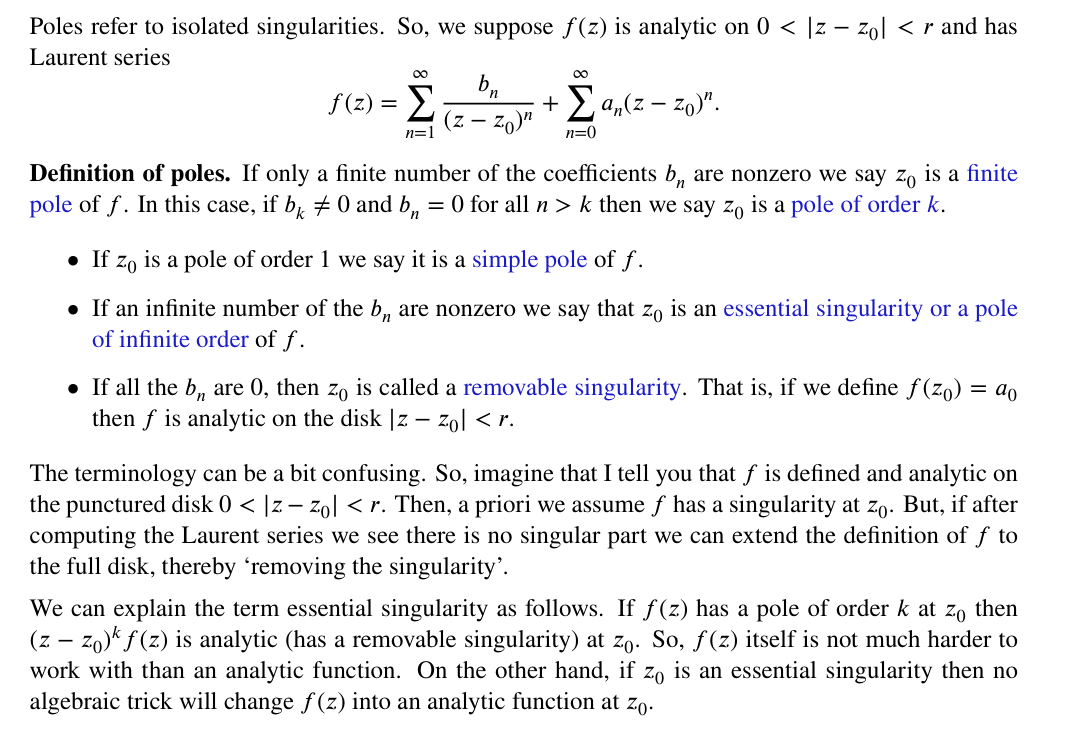
  • poles
    alt text
  • residue
    consider the function f with isolated singularity at z0z_0,i.e at 0<zz0<r0<|z-z_0|<r,the residue at z0 is b1
    denoted by Res(f,z0)Res(f,z_0) or Resz=z0f=b1\mathop{Res}\limits_{z=z_0}f=b_1
    if γ\gamma is small,simple closed curve γf(z)=2πib1\int_{\gamma}f(z)=2\pi ib_1

problemset4&5

alt text

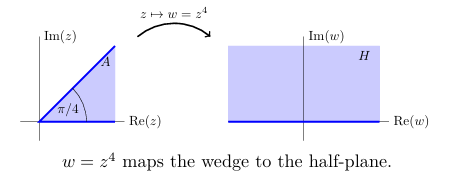
  • 找函数满足边界都是0,axis of x,0 π40~\frac{\pi}{4}四次方就能映射到整个上半平面(指数表达方法)

Residual theorem

pole(zero):分式(整式)的次数
holomorphic:equal to analytic
meromorphic:a function analytic except a set of poles of finite orders

  • behavior near zero and pole
    f(z)an(zz0)n (zero) bn(zz0)n (pole)f(z)\approx a_n(z-z_0)^n\text{ (zero) }\frac{b_n}{(z-z_0)^n}\text{ (pole)}
  • Picards theorem
    if a function has essential singularity(不是可去奇点也不是极点的奇点) at z0z_0,then in the neighbor of it,the function take on all values infinite times possibly except one value
  • quotient of function(函数的商)
    h(z)=f(z)g(z)h(z)=\frac{f(z)}{g(z)}
    let f has zero of order m,g has zero of order n,then h(z) has zero of order m-n(negative means n-m pole),m=n mean analytic
  • residue at simple pole
    suppose f has isolated singularity at z0z_0
    • if g(z)=(zz0)f(z)g(z)=(z-z_0)f(z) is analytic around point,then this point is either simple pole or removable singularity,Res(f,z0)=g(z0)Res(f,z_0)=g(z_0)
    • if f(z) has simple pole,then limzz0(zz0)f(z)=Res(f,z0)\mathop{lim}\limits_{z\rightarrow z_0}(z-z_0)f(z)=Res(f,z_0),limit exist also means simple pole or analytic
    • f has simple pole and g analytic,then Res(fg,z0)=g(z0)Res(f,z0)Res(fg,z_0)=g(z_0)Res(f,z_0) and if g not zero Res(f/g,z0)=1g(z0)Res(g,z0)Res(f/g,z_0)=\frac{1}{g(z_0)}Res(g,z_0)
    • if g has simple zero,then 1/g has a simple pole and Res(1/g,z0)=1g(z0)Res(1/g,z_0)=\frac{1}{g^{\prime}(z_0)}
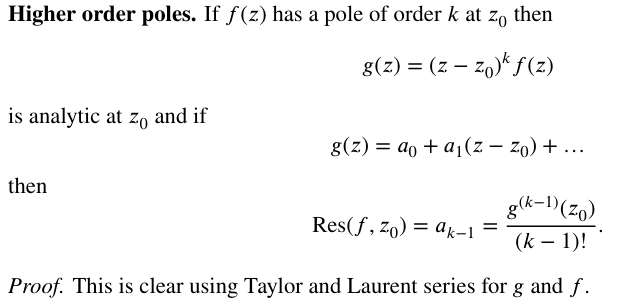
  • residue at finite pole
    alt text
  • cot(z)
    it’s fact that this function has simple pole at nπn\pi and residue of 1 at these point
  • cauchy residue theorem
    f在A上解析,有若干isolated singularities,C为不经过奇点的单连通区域边界,C上的线积分 Cf(z)dz=2πi residues of f inside C\int_C f(z)dz=2\pi i\sum \text{ residues of f inside C}
  • residue at \infty
    definition:
    when the curve is counter-clockwised,the interior is inside,when clockwised,the interior is outside
    the value of integral is defined as Res(f,)=12πiCf(z)dzRes(f,\infty)=-\frac{1}{2\pi i}\int_C f(z)dz
    where C is big enough to contain all singularities
    Res(f,)=Res(1ω2f(1ω),0)Res(f,\infty)=-Res(\frac{1}{\omega^2}f(\frac{1}{\omega}),0)

Definite integrals using the residue theorem