第五章(优化程序性能)

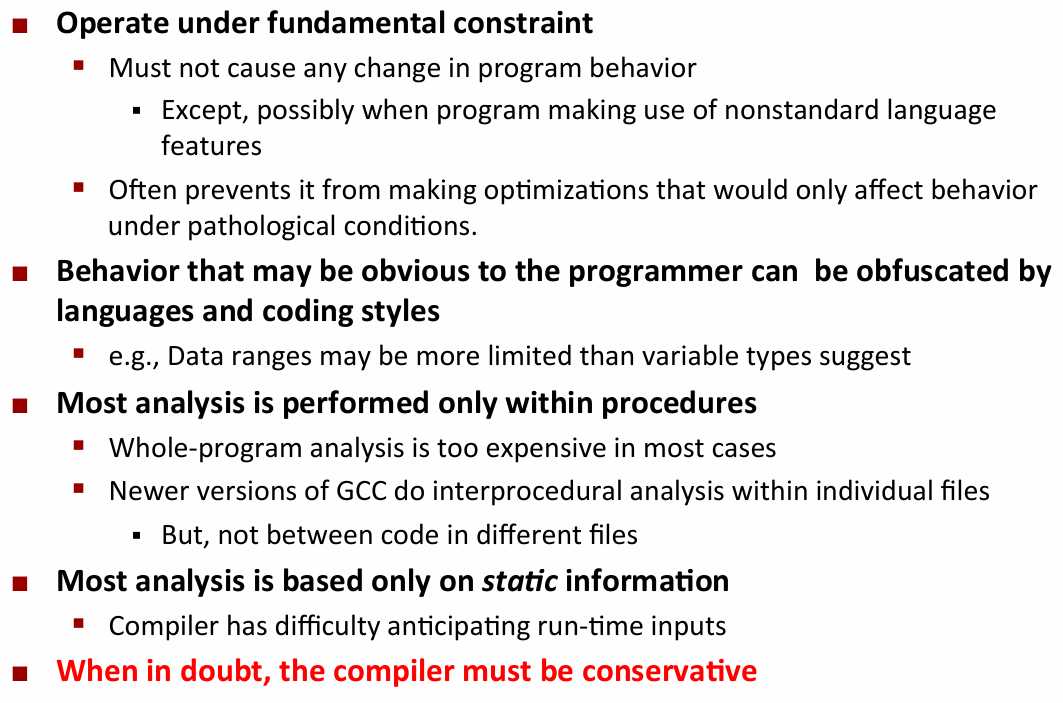
  • 编译器优化的限制

generally useful optimization

  • code motion:减少计算的频次,把相同的重复计算移动到循环外
  • reduction in strength:将昂贵的计算换成更便宜的(如乘变加和移位)
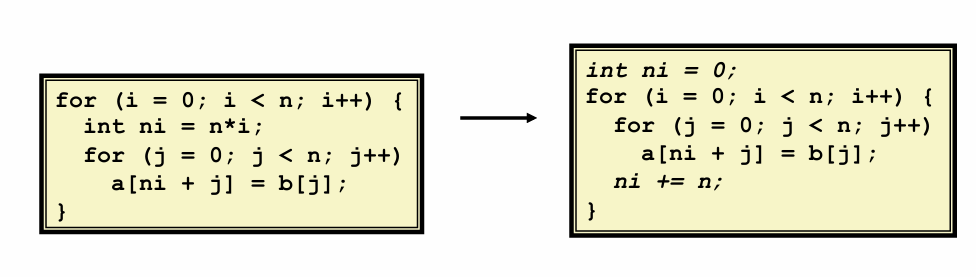
  • share common subexpressions:重复使用部分表达式

Opmization on Blocker

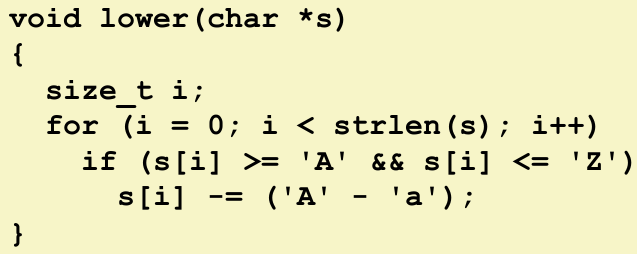
  • #1: Procedure Calls

    • 实际上该代码的运行及其低效:每次循环都算一次strlen(s),程序是平方增长的
    • 前面的编译器优化程度开高点都行,但是这个优化不了:因为编译器必须假定函数调用是黑盒,它无法确定该函数的调用会产生什么副作用
      • 可以内联来搞,也不算太good
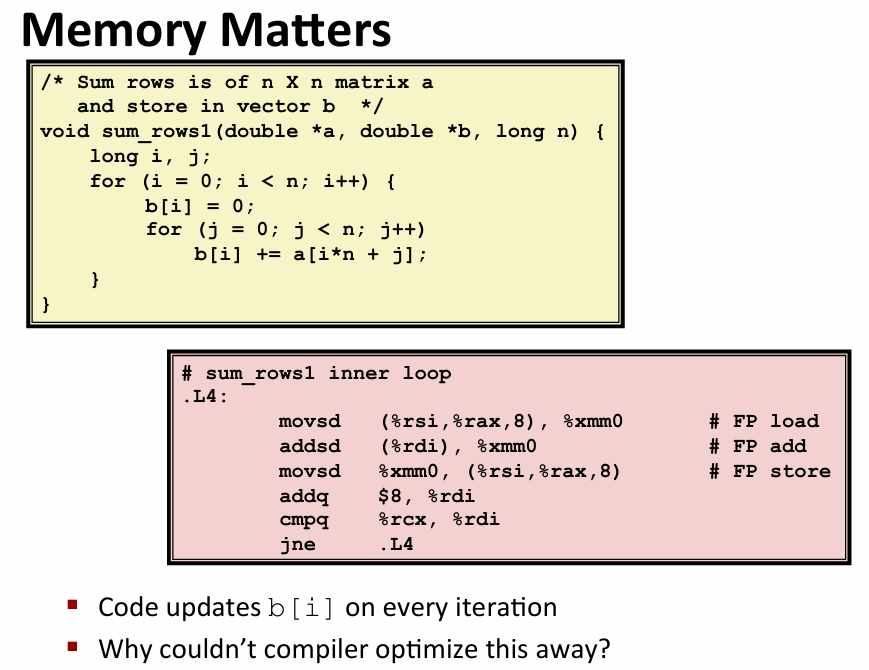
  • #2:Memory

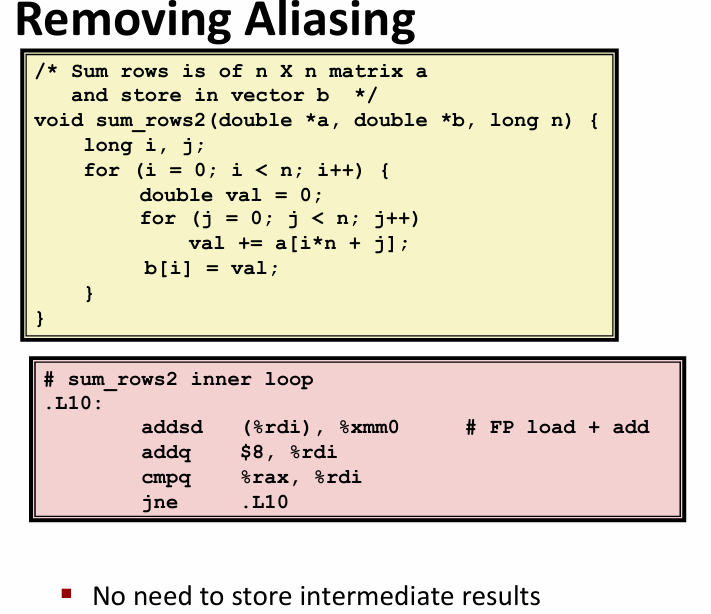
    • 编译器不能确定有无别名(aliase,即两个变量指向同一片地址),所以只能一遍一遍地从内存中读出来,算完再放回去
  • aliase实际上在c中很容易发生:可以对指针进行运算操作,同时直接访问存储结构,程序员能做的就是习惯引入局部变量

Exploing Instruction-Level Parallelism (指令级并行)
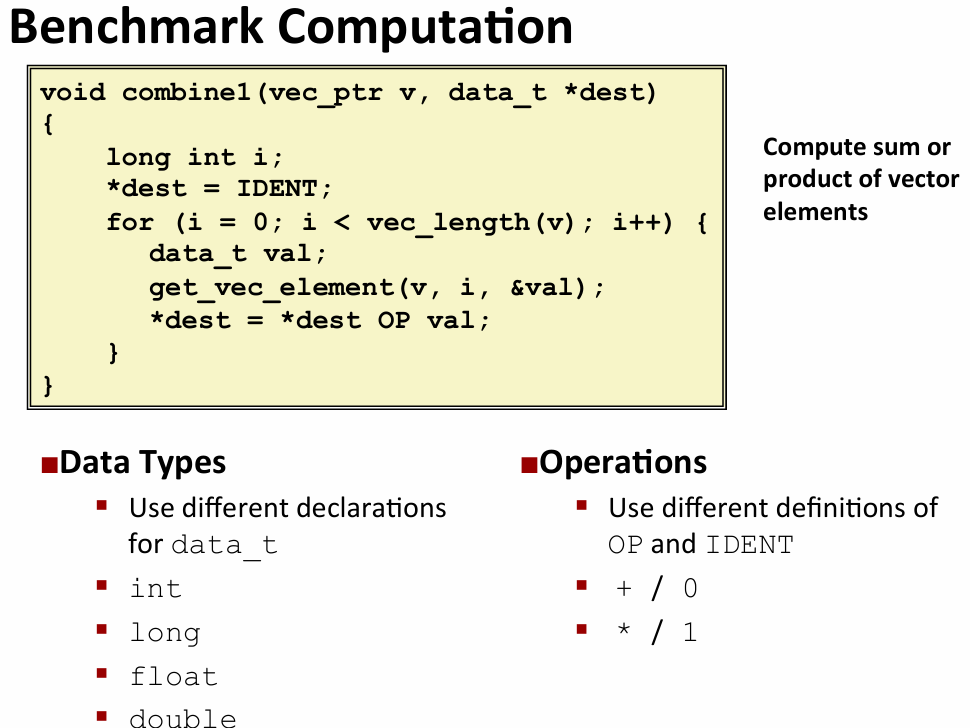
  • benchmark的两个小技巧:使用抽象的data_type 和operation实现代码复用
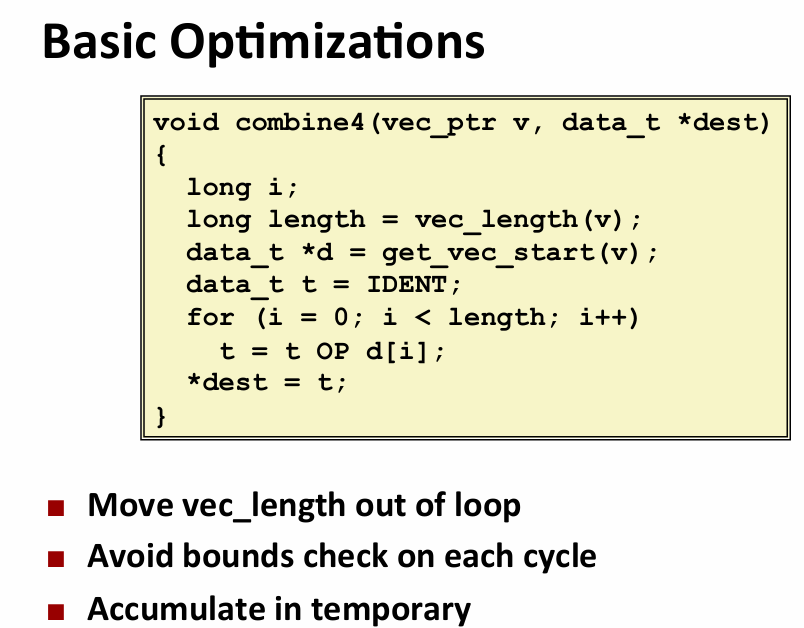
  • superscalar processor:先读取一系列指令然后根据依赖关系算
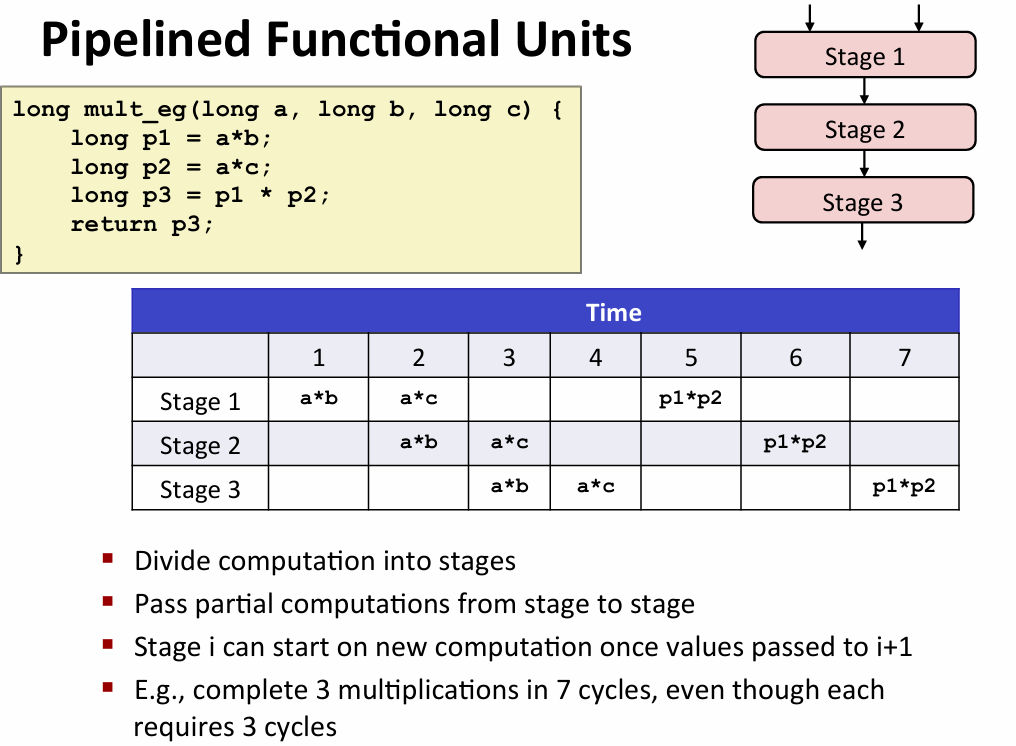
  • 流水线:(原本3*3个周期下降到7个周期)
  • 但是有些时候你的计算过程具有顺序依赖性(时间取决于latency(执行时间))
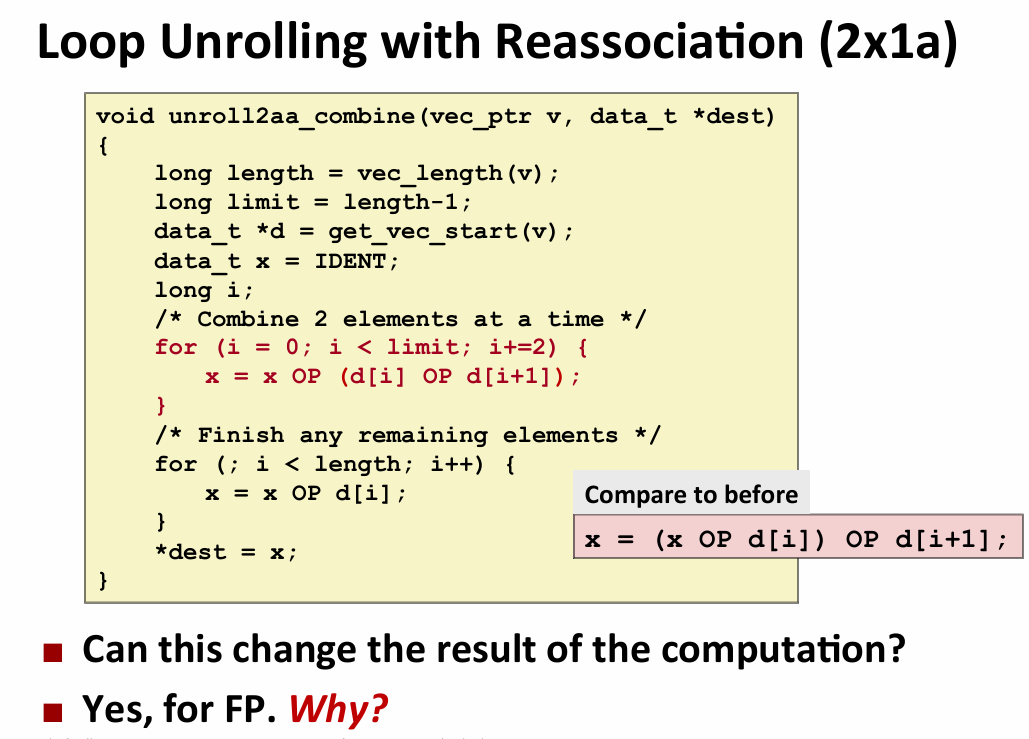
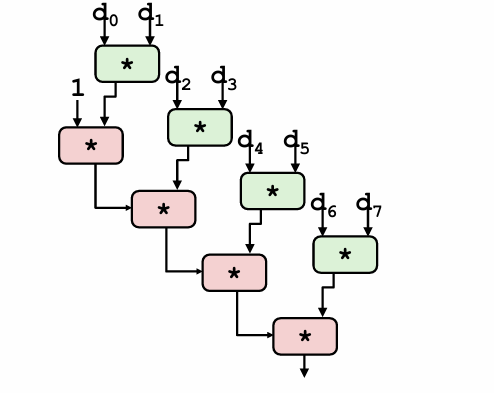
    • way:loop unrolling and reassociation
      • 事实证明这样极其有效,但是坏消息是计算浮点数很可能不能这么干
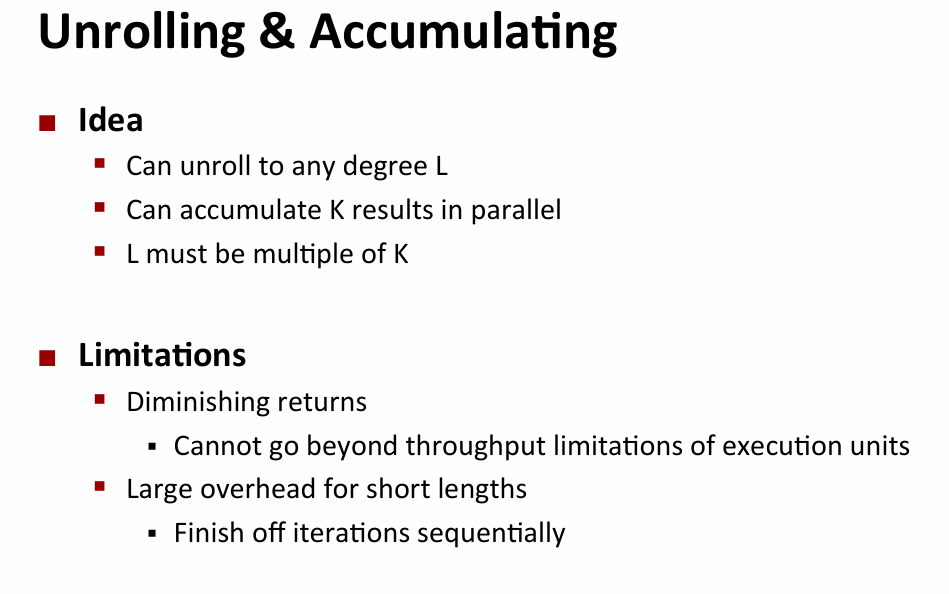
  • unrolling and accumulating的推广
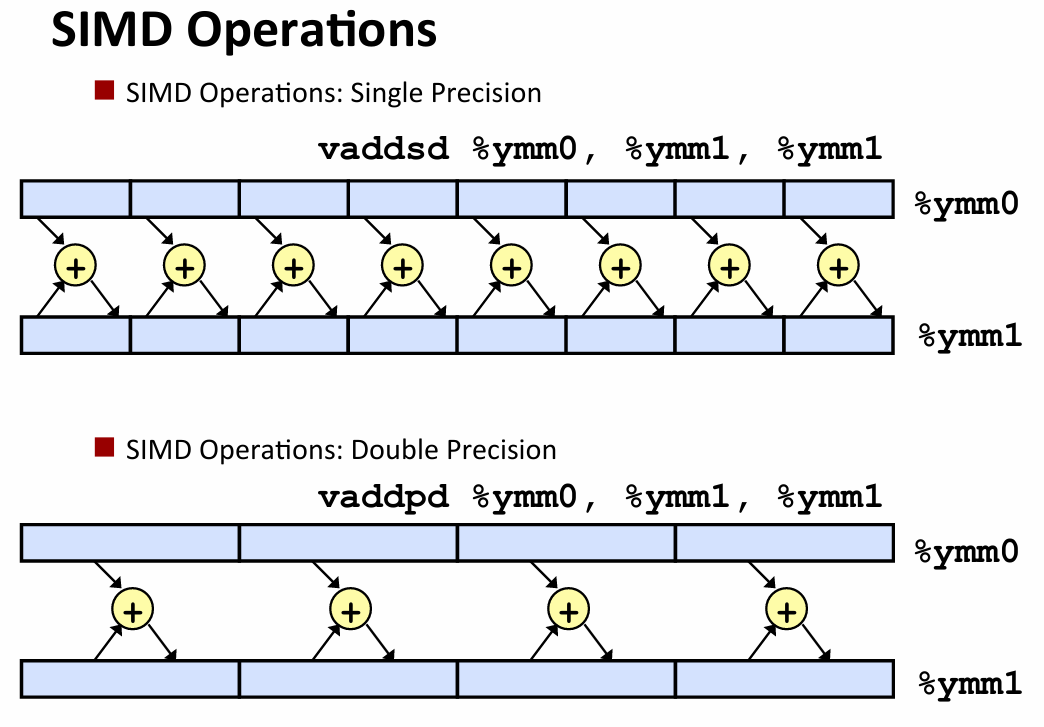
  • 还有一种矢量加法优化器
  • 分支预测:猜某个分支然后运行(但是并不真正改变寄存器和内存的值)

memory hierarchy

  • RAM(random-access memory):一组芯片,单元为cell(one bit per cell),许多RAM就形成了内存,分为SRAM和DRAM
    • sram更复杂,高速,无需错误检查什么的,很贵,当缓存用
    • dram用作主存,frame buffers,需要refresh(持续供电以保持数据)
    • dram sram都是volatile memory(易失内存,断电丢失)
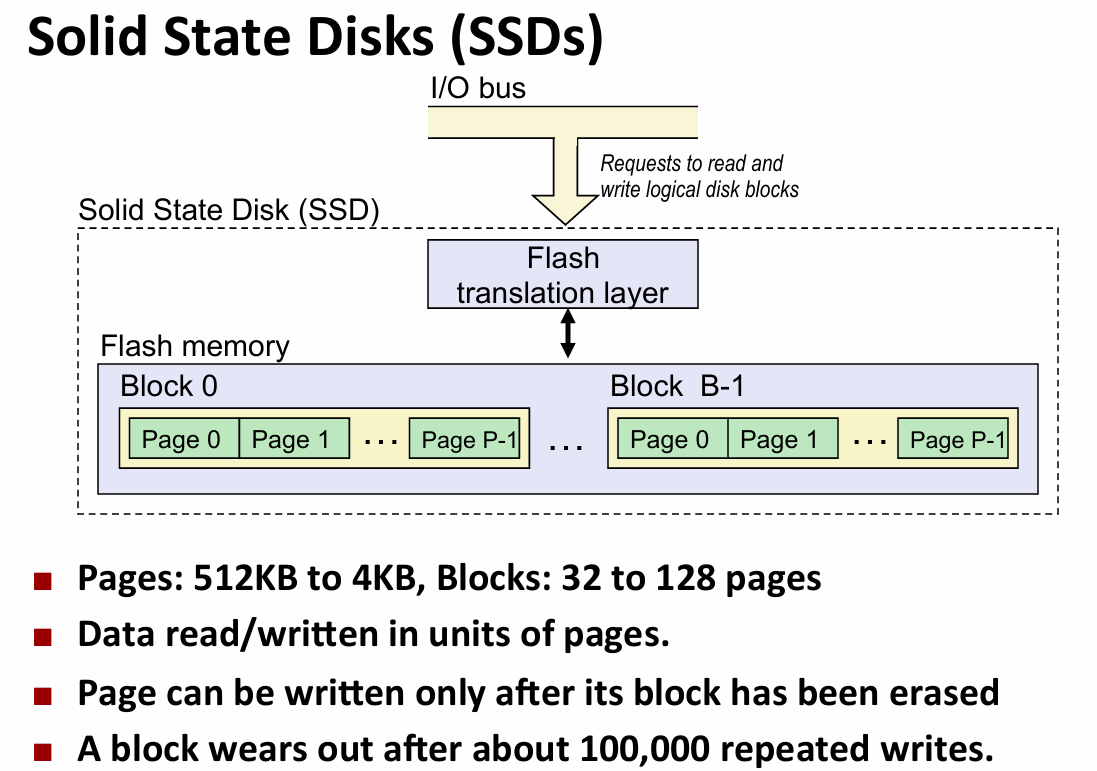
  • non volatile:ROM(read-only memories)闪存也是一种ROM
    • 用处:存bios等,solid state disks(SSD),disk caches
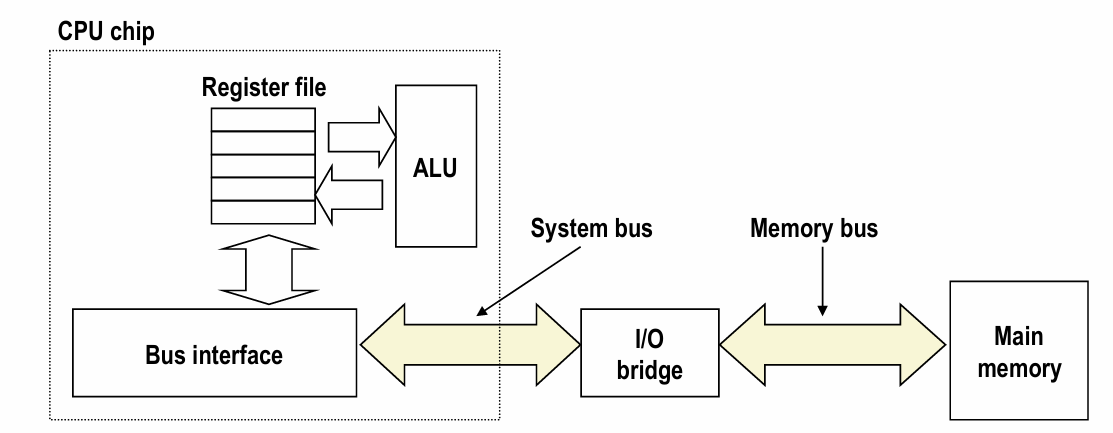
  • load operation: movq A %rax

    • cpu 把地址放在memory bus上
    • 主存从bus上读取A,检索相应数据x,再放回bus
    • cpu从bus上读取并将其复制到寄存器中(store基本同理)
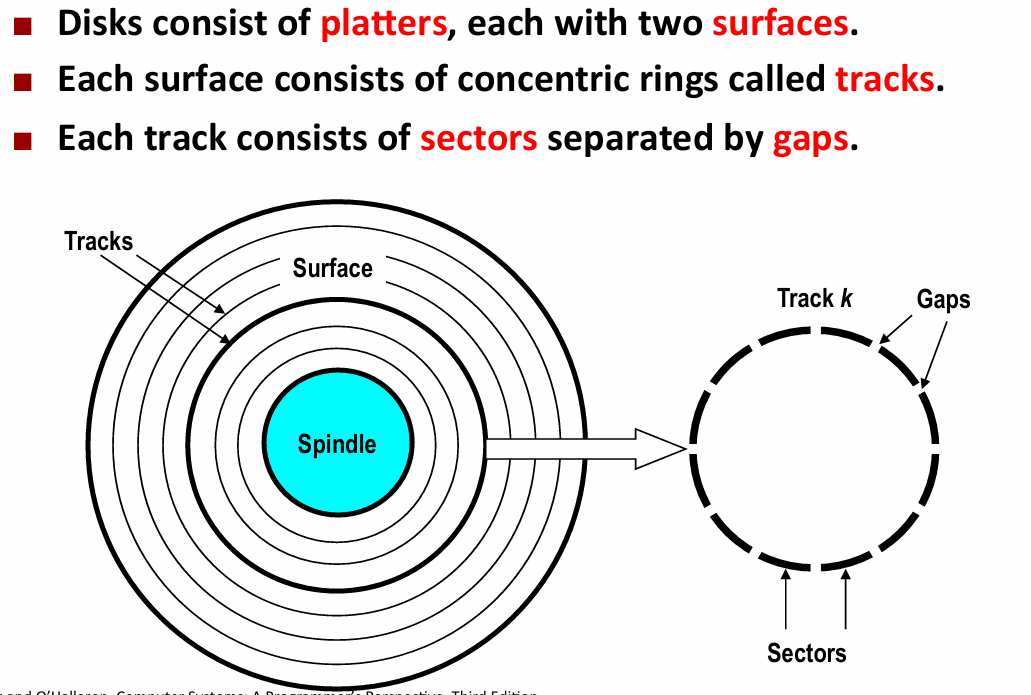
  • 磁盘:

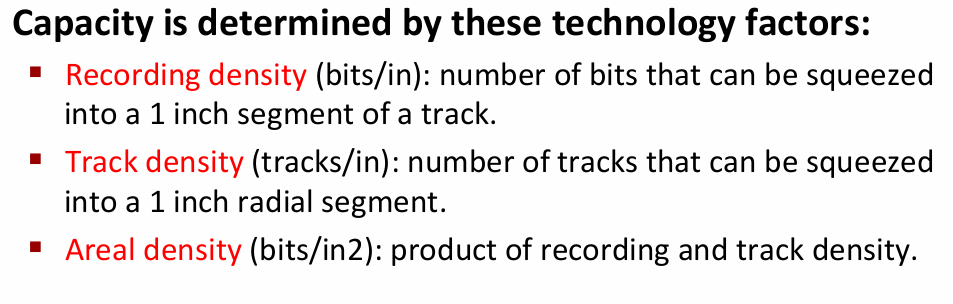
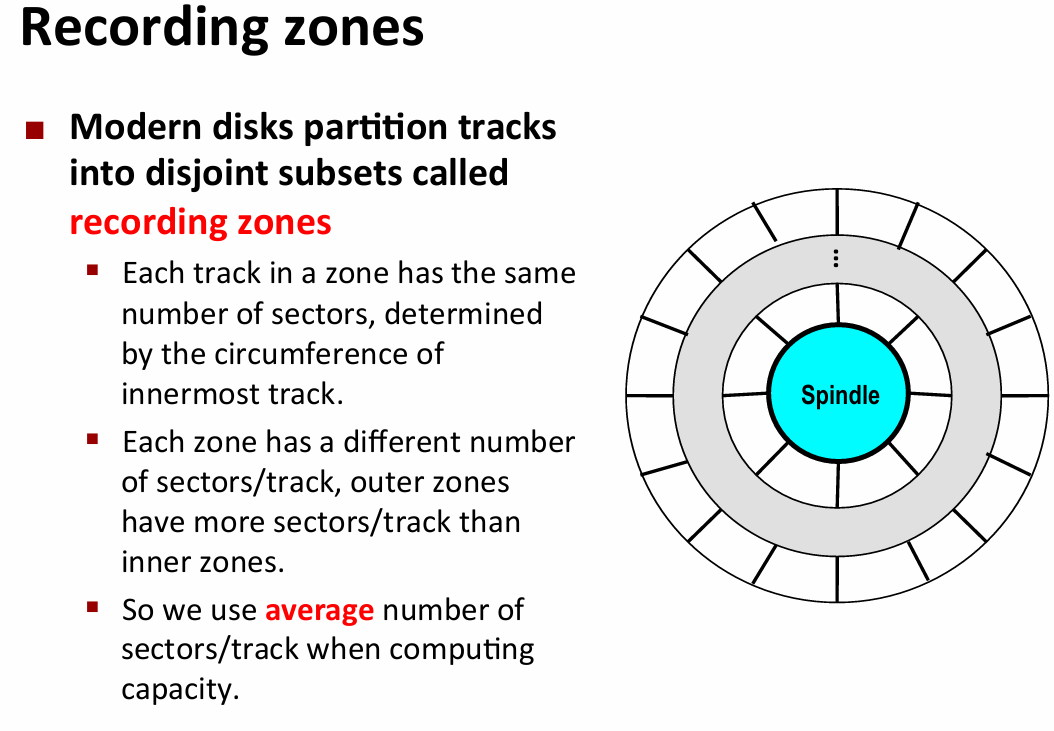
    • 容量:经典虚标(用十进制来算,密度:长乘宽)

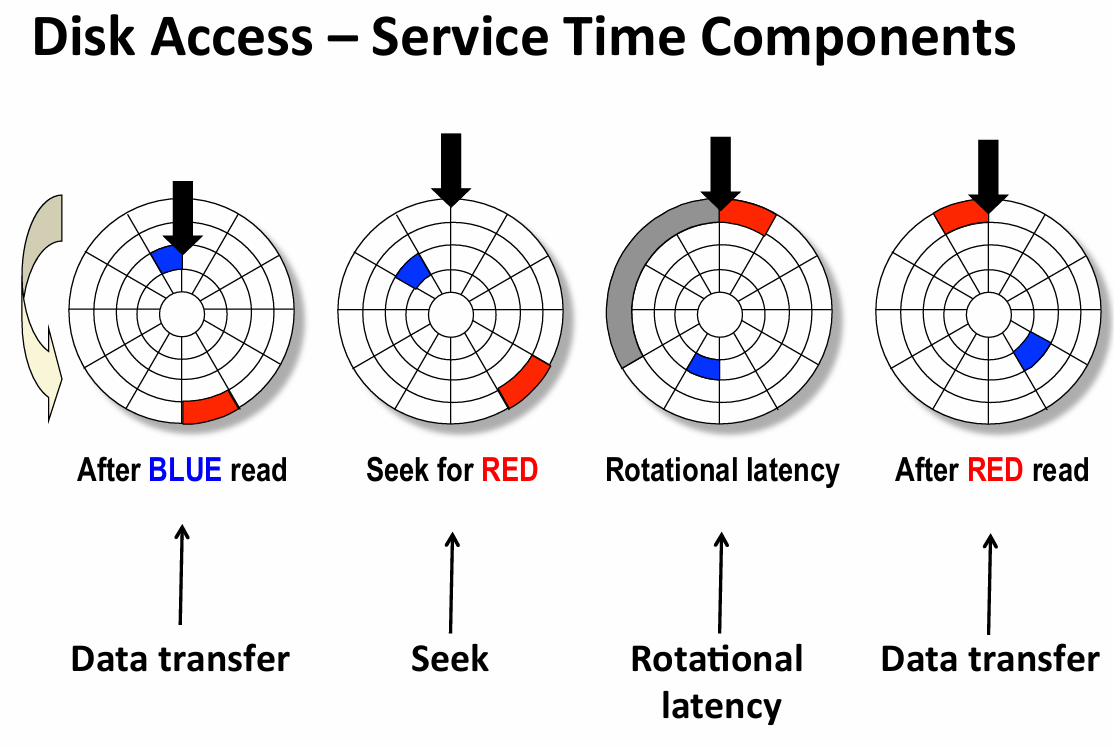
    • 磁盘访问
      • 主要时间瓶颈是seek和rotation latency
    • 现代磁盘为cpu提供了简单逻辑块抽象(sector),对其进行编号,然后控制负责维护从逻辑块到实际物理区域的映射
      • 有一部分cylinders是用来备用的,故障的时候把当前数据复制到备用的就可以接着用,所以format capacity 要小于actual capacity
    • 从磁盘中读取:
      • cpu初始化了一个三元组:(指令 逻辑块编号 目标内存地址)并发送给磁盘控制器
      • 磁盘控制器读取并存放到内存中,当它读完了才会发送一个interupt信号提示cpu读取完毕
      • 这种设计可以让cpu在等待读取完成的同时干别的

locality of reference

  • principle of locality: Programs tend to use data and instructions with addresses near or equal to those they have used recently
    • temporal locality:最近引用过的数据有可能在将来再次被引用
    • spatial locality:引用过的数据的相邻位置的数据更有可能被引用
  • 作为程序员最重要的能力:qulitative estimation of locality
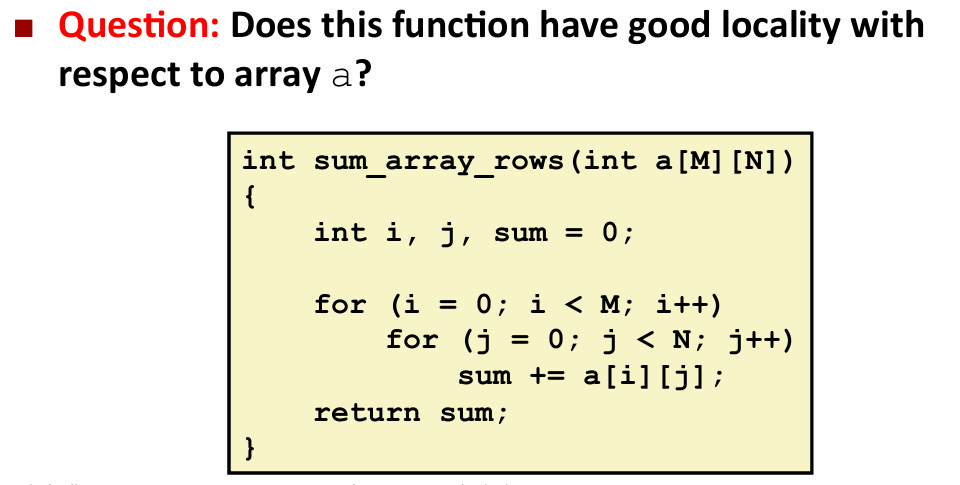
      • 步长为1的线性访问模式,非常好的空间局部性

caching in memory hierarchy
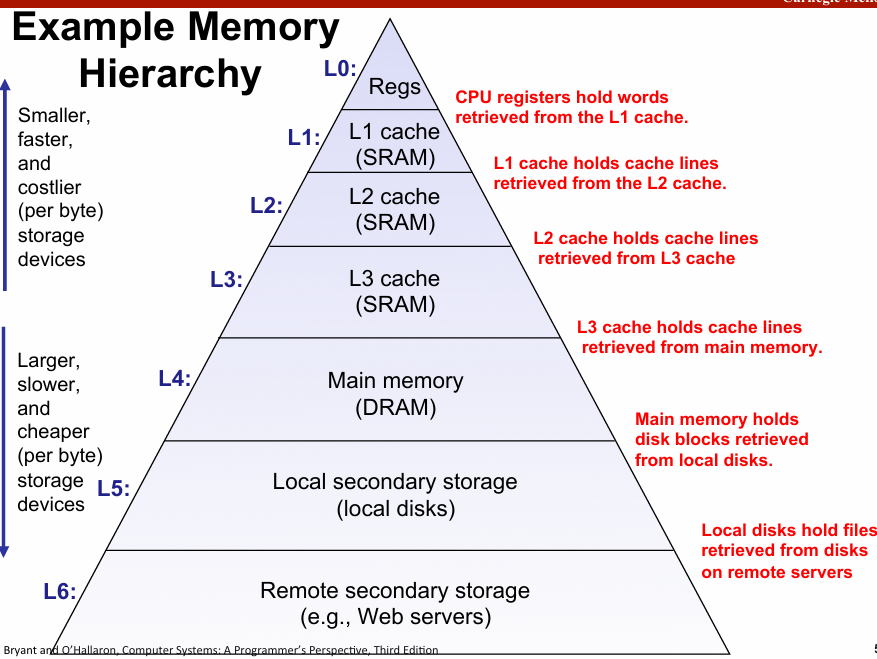
  • 缓存允许我们以最高层的速度访问处理最底层容量的数据
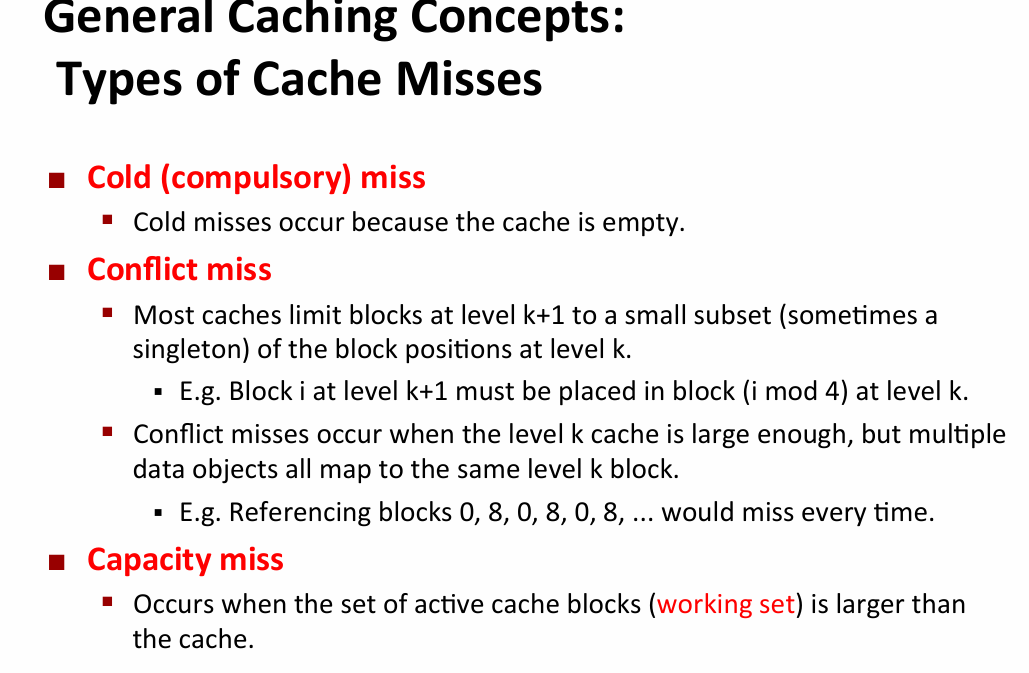
  • 数据在缓存中:缓存命中(hit),反之则是(miss)

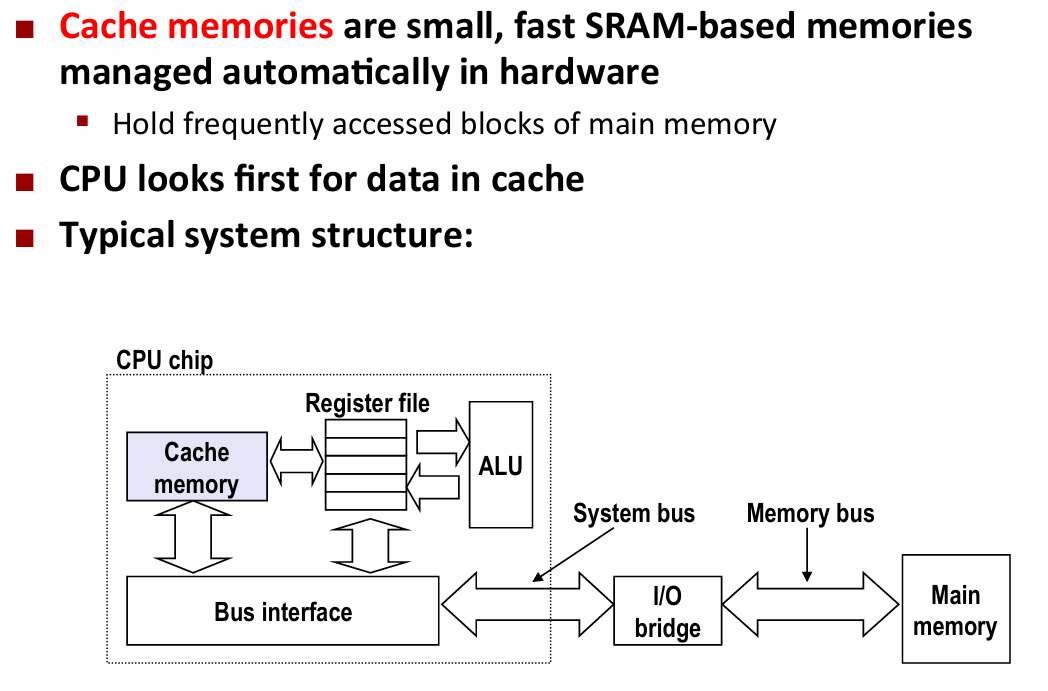
cache memories

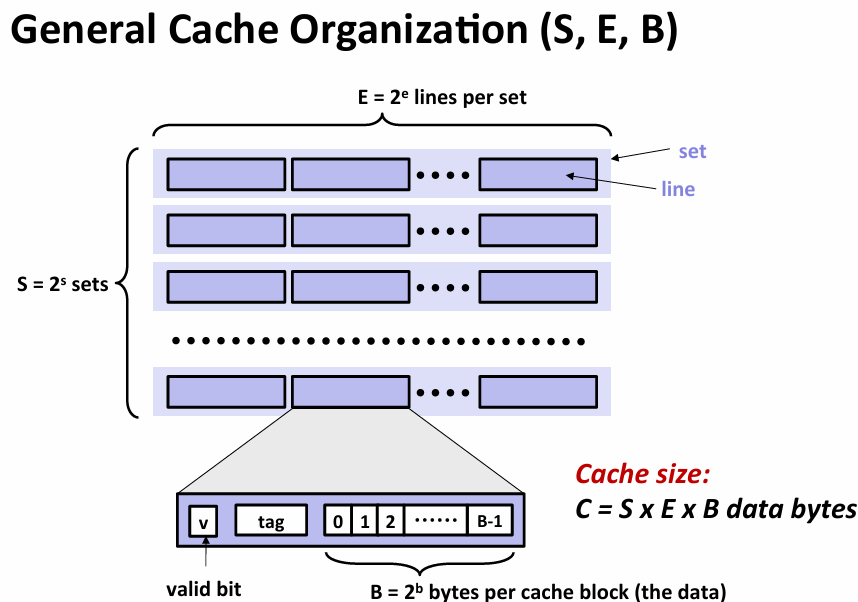
Cache memory organization and operation

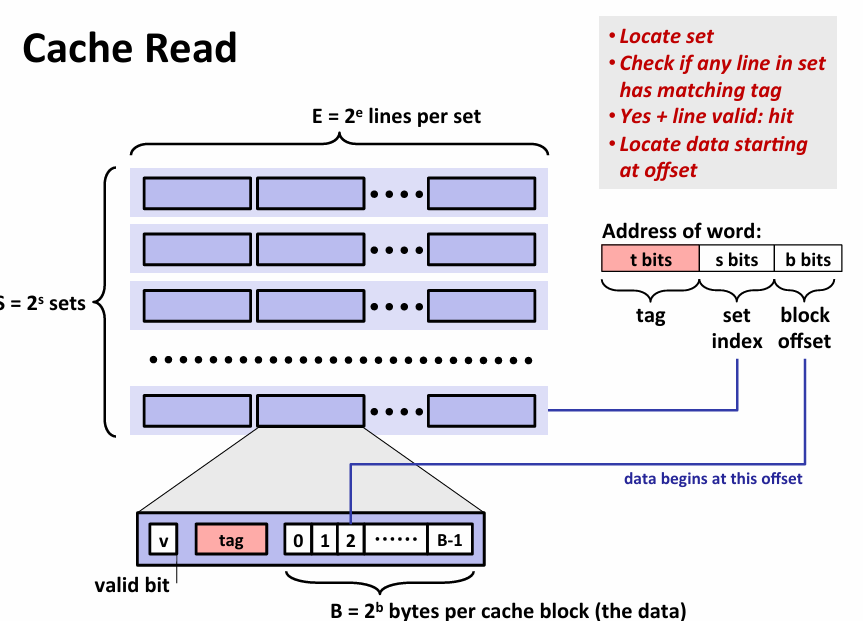
  • read
    • 当e=1时,称direct mapped cache,实际上相当之低效
    • 块的设计初衷就是为了利用空间局部性,但是大小设计相当棘手(trade-off)
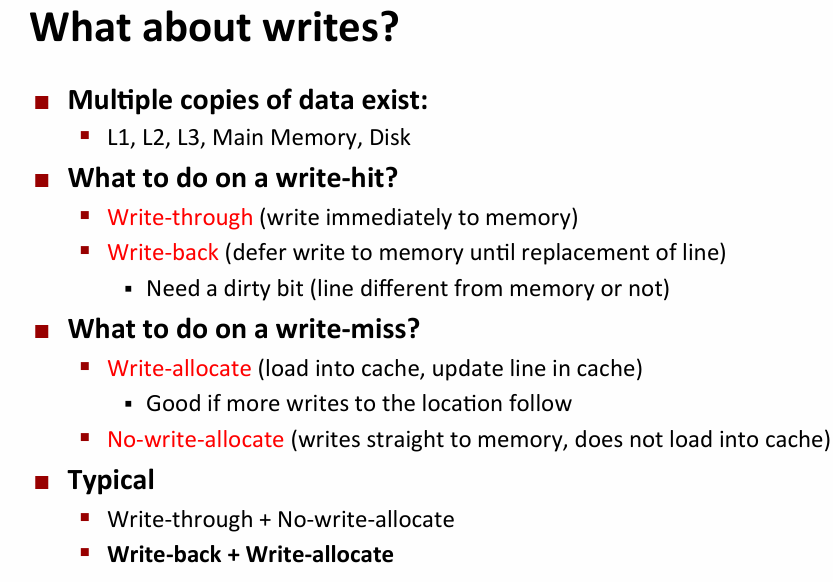
    • 缓存中的替换:很多种算法,最近最少,你要重新写回内存因为可能发生变化
  • write
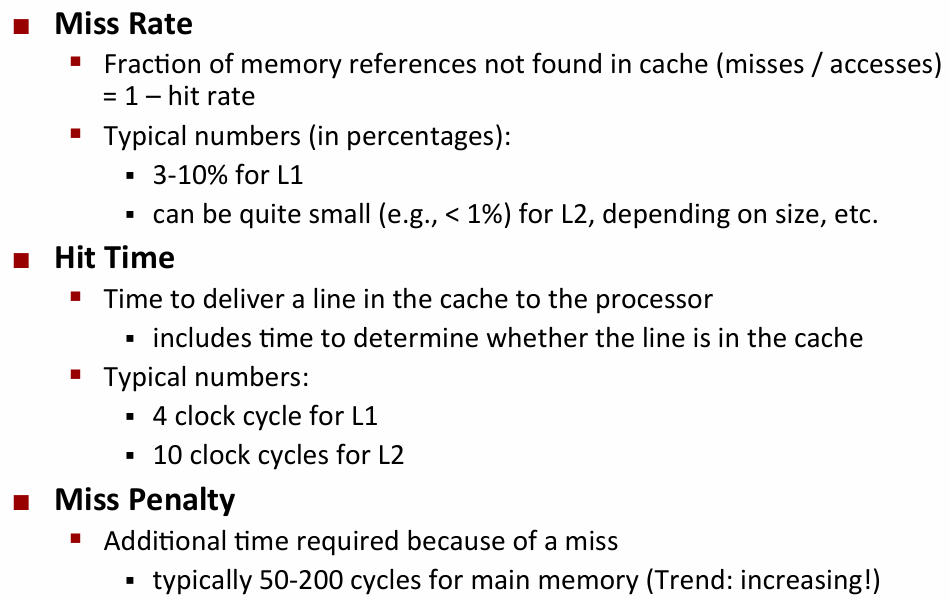
  • 衡量缓存的指标

performance impact of caches

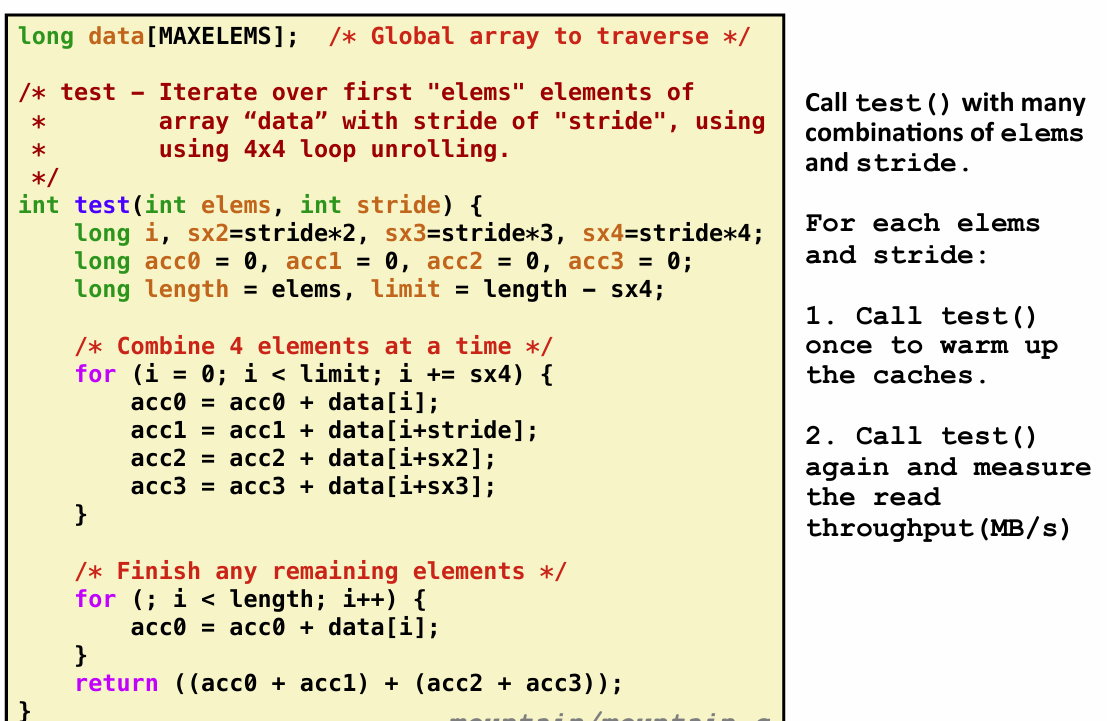
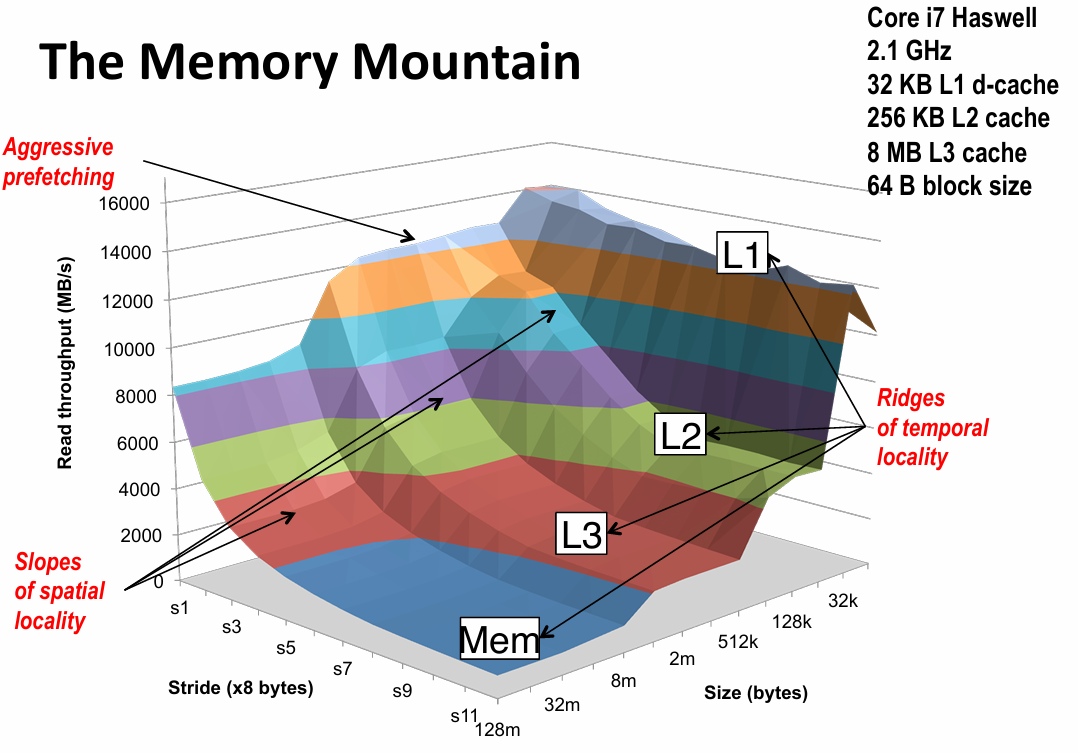
  • memory mountain
    • read throughput:number of bytes read from memory per second
    • memory mountain:measured read throughput as a function of spatial and temperal locality
    • 增大stride:减小空间局部性,增大size:减小时间局部性(因为size更大了之后高级缓存放不下了)
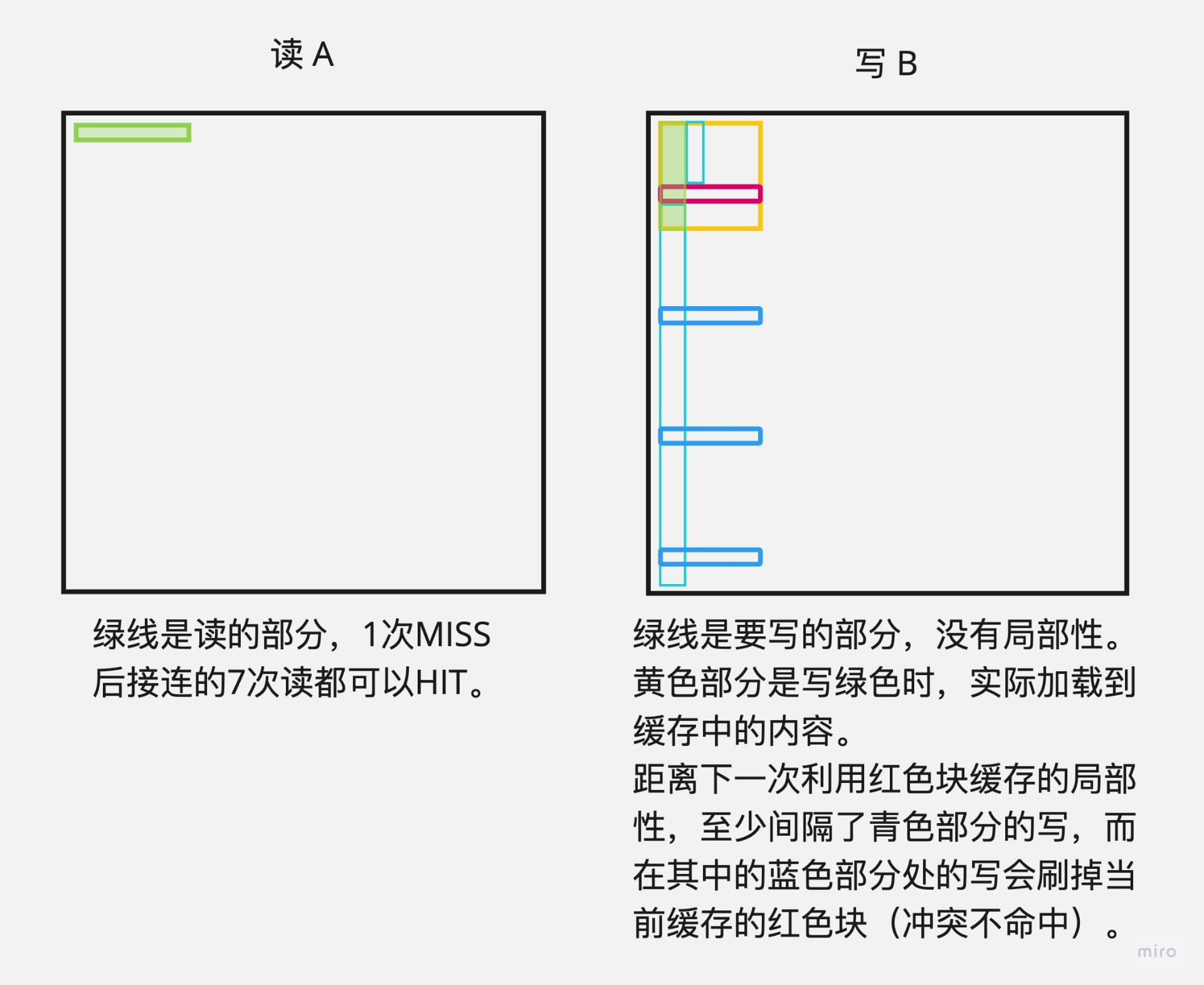
  • rearranging loop for better spatial locality
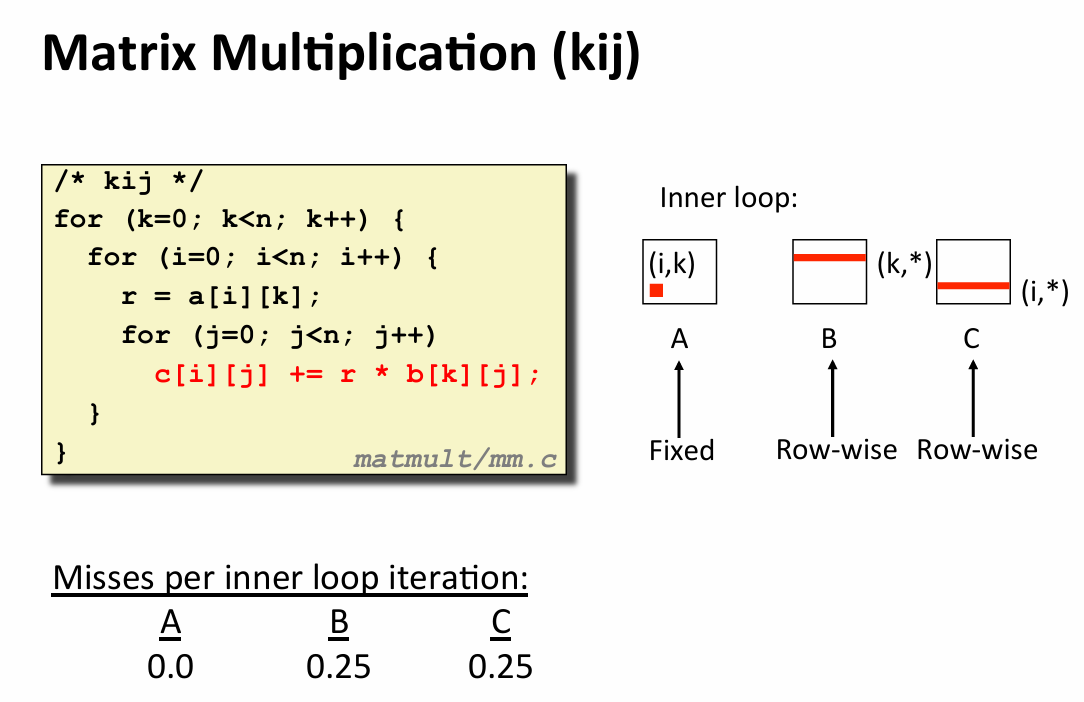
    • 这种有额外的存储开销:但是在现代系统中写比读容易得多,不会成为瓶颈
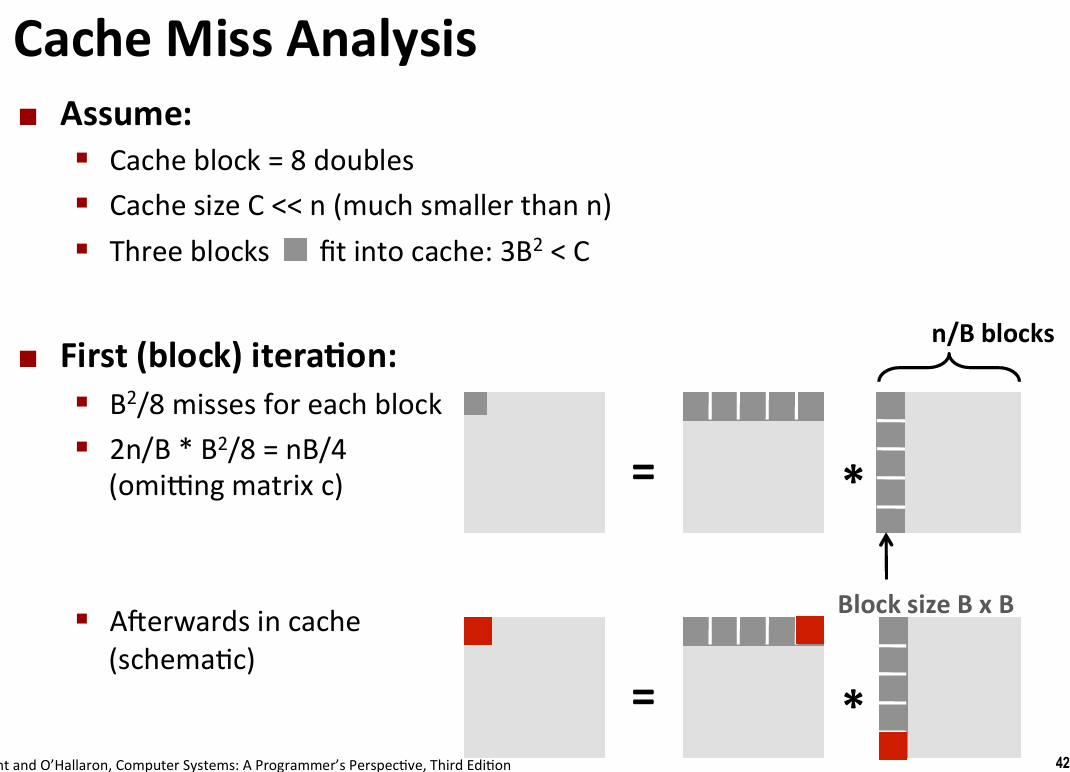
  • blocking

cachelab

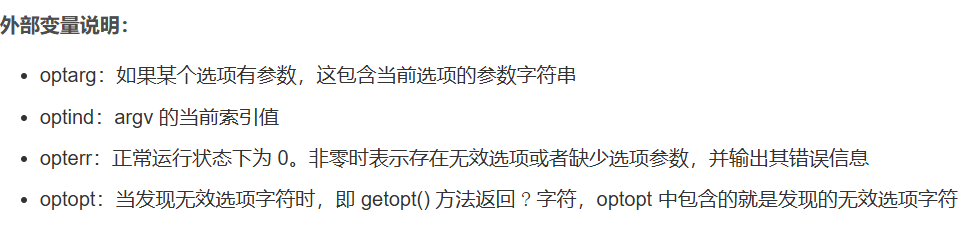
  • getopt():包含在unistd.h中的函数,用于解析程序的命令行参数
    • int getopt(int argc,char* const argv[],const char* opstring)
    • opstring:"abc:"表示-a -b普通选项加上一个必须有参数的-c选项
    • 两个冒号为可选参数
  • 模拟内存访问
#include "cachelab.h"
#include <unistd.h>
#include <getopt.h>
#include <stdlib.h>
#include <stdio.h>
#include <limits.h> // 为了使用 INT_MAX

typedef struct cache_line {
int validbit;
unsigned long tags; // 地址是64位的,建议用 unsigned long
int LRU; // 记录时间戳
} cache_line;

typedef struct cache {
cache_line** item;
int S; // 组的数量 (2^s)
int E; // 每组的行数 (Associativity)
int B; // 块大小 (2^b)
int s_bits; // 保存原始的 s 值,用于位移计算
int b_bits; // 保存原始的 b 值,用于位移计算
int time; // 全局时间计数器
} cache;

typedef struct state {
int hits;
int misses;
int evictions;
} state;

/**
* 核心缓存访问逻辑
* 合并了 load/store/modify 的公共部分
*/
void access_cache(unsigned long address, state* s, cache* c) {
// 1. 计算组索引 (Set Index)
// 逻辑:(地址 >> b位) & (S - 1)
unsigned long set_index = (address >> c->b_bits) & (c->S - 1);

// 2. 计算标记 (Tag)
// 逻辑:地址 >> (s位 + b位)
unsigned long tag = address >> (c->s_bits + c->b_bits);

cache_line* current_set = c->item[set_index];

// --- 第一步:检查 Hit ---
for (int i = 0; i < c->E; i++) {
if (current_set[i].validbit == 1 && current_set[i].tags == tag) {
s->hits++;
current_set[i].LRU = c->time; // 更新 LRU 时间
return;
}
}

// --- 第二步:处理 Miss ---
s->misses++;

int empty_idx = -1; // 空闲行的索引
int lru_idx = -1; // 需要被驱逐行的索引
int min_lru = INT_MAX;

// 寻找空行 或者 LRU 最小的行
for (int i = 0; i < c->E; i++) {
if (current_set[i].validbit == 0) {
empty_idx = i;
break; // 找到空行直接停止,优先使用空行
}
if (current_set[i].LRU < min_lru) {
min_lru = current_set[i].LRU;
lru_idx = i;
}
}

if (empty_idx != -1) {
// 有空行,直接填入
current_set[empty_idx].validbit = 1;
current_set[empty_idx].tags = tag;
current_set[empty_idx].LRU = c->time;
} else {
// 没有空行,发生驱逐 (Eviction)
s->evictions++;
current_set[lru_idx].tags = tag;
current_set[lru_idx].LRU = c->time;
// validbit 已经是 1 了,无需修改
}
}

int main(int argc, char* argv[]) {
state* sta = (state*)malloc(sizeof(state));
sta->hits = 0;
sta->misses = 0;
sta->evictions = 0;

int option;
int s_in = 0, e_in = 0, b_in = 0; // 接收输入的参数
FILE* f = NULL;

// 解析命令行参数
while ((option = getopt(argc, argv, "hvs:E:b:t:")) != -1) {
switch (option) {
case 'h':
printf("Usage: ./csim -s <num> -E <num> -b <num> -t <file>\n");
exit(0);
case 'v':
// verbose 模式,如有需要可添加打印逻辑
break;
case 's':
s_in = atoi(optarg);
break;
case 'E':
e_in = atoi(optarg);
break;
case 'b':
b_in = atoi(optarg);
break;
case 't':
f = fopen(optarg, "r");
break;
}
}

if (s_in == 0 || e_in == 0 || b_in == 0 || f == NULL) {
printf("Missing required arguments.\n");
return 1;
}

// 初始化 Cache 结构体
cache* cache_si = (cache*)malloc(sizeof(cache));
cache_si->s_bits = s_in; // 保存位数 s
cache_si->b_bits = b_in; // 保存位数 b
cache_si->S = 1 << s_in; // 计算 S = 2^s
cache_si->E = e_in;
cache_si->B = 1 << b_in; // 计算 B = 2^b
cache_si->time = 0;

// 动态分配二维数组
cache_si->item = (cache_line**)malloc(sizeof(cache_line*) * cache_si->S);
for (int i = 0; i < cache_si->S; i++) {
cache_si->item[i] = (cache_line*)malloc(sizeof(cache_line) * cache_si->E);
for (int j = 0; j < e_in; j++) {
cache_si->item[i][j].LRU = 0;
cache_si->item[i][j].tags = 0;
cache_si->item[i][j].validbit = 0;
}
}

char operation;
unsigned long address;
int size;

// 读取 trace 文件
// 注意 " %c" 前面的空格,用于跳过空白符
while (fscanf(f, " %c %lx,%d", &operation, &address, &size) != -1) {

// 通常忽略指令加载 'I'
if (operation == 'I') continue;

cache_si->time++; // 增加全局时间

switch (operation) {
case 'L': // Load 数据加载
access_cache(address, sta, cache_si);
break;

case 'S': // Store 数据存储
access_cache(address, sta, cache_si);
break;

case 'M': // Modify 数据修改 (先读后写)
access_cache(address, sta, cache_si); // 第一次访问(可能 Miss/Evict)
sta->hits++; // 第二次访问(必定 Hit)
break;
}
}

printSummary(sta->hits, sta->misses, sta->evictions);

// 释放内存 (良好的编程习惯)
fclose(f);
for (int i = 0; i < cache_si->S; i++) {
free(cache_si->item[i]);
}
free(cache_si->item);
free(cache_si);
free(sta);

return 0;
}
  • 针对特定size的矩阵的block优化
void transpose_submit(int M, int N, int A[N][M], int B[M][N])
{
for (int i = 0; i < 32; i += 8) {
for (int j = 0; j < 32; j += 8) {
for (int ii = i; ii < i + 8; ii++) {
for (int jj = j; jj < j + 8; jj++) {
B[jj][ii] = A[ii][jj];
}
}
}
}

void transpose_64x64(int M, int N, int A[N][M], int B[M][N])
{
int a_0, a_1, a_2, a_3, a_4, a_5, a_6, a_7;
for (int i = 0; i < 64; i += 8){
for (int j = 0; j < 64; j += 8){
for (int k = i; k < i + 4; k++){
// 得到A的第1,2块
a_0 = A[k][j + 0];
a_1 = A[k][j + 1];
a_2 = A[k][j + 2];
a_3 = A[k][j + 3];
a_4 = A[k][j + 4];
a_5 = A[k][j + 5];
a_6 = A[k][j + 6];
a_7 = A[k][j + 7];
// 复制给B的第1,2块
B[j + 0][k] = a_0;
B[j + 1][k] = a_1;
B[j + 2][k] = a_2;
B[j + 3][k] = a_3;
B[j + 0][k + 4] = a_4;
B[j + 1][k + 4] = a_5;
B[j + 2][k + 4] = a_6;
B[j + 3][k + 4] = a_7;
}
for (int k = j; k < j + 4; k++){
// 得到B的第2块
a_0 = B[k][i + 4];
a_1 = B[k][i + 5];
a_2 = B[k][i + 6];
a_3 = B[k][i + 7];
// 得到A的第3块
a_4 = A[i + 4][k];
a_5 = A[i + 5][k];
a_6 = A[i + 6][k];
a_7 = A[i + 7][k];
// 复制给B的第2块
B[k][i + 4] = a_4;
B[k][i + 5] = a_5;
B[k][i + 6] = a_6;
B[k][i + 7] = a_7;
// B原来的第2块移动到第3块
B[k + 4][i + 0] = a_0;
B[k + 4][i + 1] = a_1;
B[k + 4][i + 2] = a_2;
B[k + 4][i + 3] = a_3;
}
for (int k = i + 4; k < i + 8; k++)
{
// 处理第4块
a_4 = A[k][j + 4];
a_5 = A[k][j + 5];
a_6 = A[k][j + 6];
a_7 = A[k][j + 7];
B[j + 4][k] = a_4;
B[j + 5][k] = a_5;
B[j + 6][k] = a_6;
B[j + 7][k] = a_7;
}
}
}
}

  • 其它的分块思路:先分8*8再在小块里面分4*4